And Then There Were None

We received an email tonight from our adoption agency. The 3 year old girl and 6 year old boy we were hoping to adopt have been claimed by another family member who wants to try to raise them there in the Democratic Republic of Congo.

Although we’ve not spoken much of them specifically, we really did hope that those were the two children we were to adopt.  We’re happy that they were reunited with family — we were just hoping that family would be ours.

So where does this leave us? Our agency will begin looking for a new referral for us. We still believe that we should adopt more than one child, and our hope is to keep siblings from being split up. Typically, there is no wait for a referral for children over 3 in the Democratic Republic of Congo, so we are hopeful that we will be matched again very soon. Our overall timeline will likely not even change.

But we must face the fact that it is another loss in what seems to be a pretty long string of losses this year.

Adoption is harder than it looks.

The cloak is feeling a little scratchy tonight.

The Changing Cloak

I had lunch with a dear friend today, and as we chatted, one of the topics that came up was the return to new normalcy after an intense time of grief, which both of us have experienced in the past few months.

To be a joyful person enshrouded by grief is difficult. The cloak of grief placed unwillingly on a happy heart is a difficult and unwelcome experience. The laughter that once was freely flowing seems to offend the garment, to betray that which was lost, to deny the devastation of the heart.

Yet, the garment of grief doesn’t fit right – binding in some areas, saggy in others, always dragging the ground. The burlaped texture of gristly grief chafes my already thin skin. The overwhelming weight is wearisome.

There have been times that I have thought that I was becoming accustomed the shroud, only to realize that its presence was clearly felt on my shoulders again. Getting a new bill in the mail for the adoption that never existed. Being asked by a friend unacquainted with our situation, “How are the twins?” Finding tiny baby items that I tucked away for the future — a future that will never come.  

But I do not have a choice of apparel. The cloak must be worn dutifully, and eventually, worn submissively.

Over time, I have found that the misshapen shroud of grief has transformed. I’ve tucked it in on one side, tied it on the other to better fit my soul. The once-abrasive fibers have softened. My skin has thickened as well. The heaviness is still present, but rather than being oppressive, if I consider it, it is now feels much more like warmth.

Could it be that the shroud of grief has become a cloak of God’s consolation? Could it be that the garment that I once resisted is the very means of grace by which God has chosen to demonstrate the closeness of His comfort?

Perhaps this is what Jesus spoke of in the Beatitudes, when He said, “You’re blessed when you feel you’ve lost what is most dear to you. Only then can you be embraced by the One most dear to you.” Matthew 5:4, The Message

It may not be that the cloak itself has been transformed nearly as much as the cloak has transformed me. Now laughter does not betray comfort. Joy does not deny the embrace of the Almighty. Smiles are an expression of love, not a betrayal of such. Though my life has been forever changed by the donning of the cloak, I’ve come to realize that it is not an instrument of hardship as much as it is a demonstration of love.

Unsafe in His Hands

Along our adoption journey, we have been asked many questions about our process and about where we are going to go get our children. The Democratic Republic of Congo has just recently opened to international adoption, and in fact, up until May of this year, parents were urged not to go there to get their children, but to have them escorted back to the United States because of safety concerns.

Is traveling to the Democratic Republic of Congo dangerous? Absolutely.  And that’s exactly why we must go. Orphans whom we were called to adopt are there, and it’s an even more dangerous place for them.

The truth is, our adoption journey has not been a safe one even thus far. We have been hurt. We have been robbed. We have been shamed. But we have not lost sight of the fact that every step of our adoption journey has been ordained by God.

Nevertheless, God does not lead us to safe places. David Platt, in his book Radical says,

“[God] is good. He is good even when he calls you and me to places that are dirty and disease ridden. He is good even when we end up possibly sharing in the diseases of the people we go to serve.” The diseases aren’t just AIDS or malaria or hepatitis. The diseases of some along our adoption journey have been lying, deceit, incompetence, and fraud. But that does not mean that the calling was a mistake, that our actions were in error, or that God allowed us to go down a wrong path.

Following God’s will isn’t safe. When you are doing the work of the kingdom as you follow Him, it will certainly lead you to dangerous situations. It wasn’t safe for Jesus. It wasn’t safe for His disciples, or the early Church. Why should it be safe now? David Platt writes, “To everyone wanting a safe, untroubled, comfortable life free from danger, stay away from Jesus. The danger in our lives will always increase to the depth of our relationship with Christ.”

 If we only attempt to do what is possible on our own, are we really following anyone but ourselves?

True followers of Christ attempt to do things that would be impossible without God. And that’s what He has called us to do.

We are to go into dangerous places in the world and seek out waiting orphans who have seen many other children leave the orphanage, wondering when it will be their turn, questioning if they will ever be chosen to be a part of a forever family.

We are adopting children from a different race, language, and culture. This too is dangerous, and we know the risks of developmental difficulties, trouble with bonding, and lack of societal acceptance.

We don’t know how we will pay the costs of the adoption. $28,000 is a lot of money to raise in 6 months, and as much as we plan, it will be impossible without Divine intervention. Adopting two orphans half way around the world is financially dangerous.

But our security is not in our physical safety. Neither is it in our bank accounts, jobs, or material possessions.  Our security is not in what others think of us, or even in a culturally accepted family structure.

David Platt again writes in Radical, “Indeed, God knows every detail of our lives, and when we step out in faith to follow Him, He will show us that our greatest security is not found in the comforts we can manufacture in this world but in the faithful provision of the only one who knows our needs and the only one who is able to meet our needs in every way.”

God has called us to dangerous places, and that’s exactly where our greatest safety is found.
Our Oldest Son

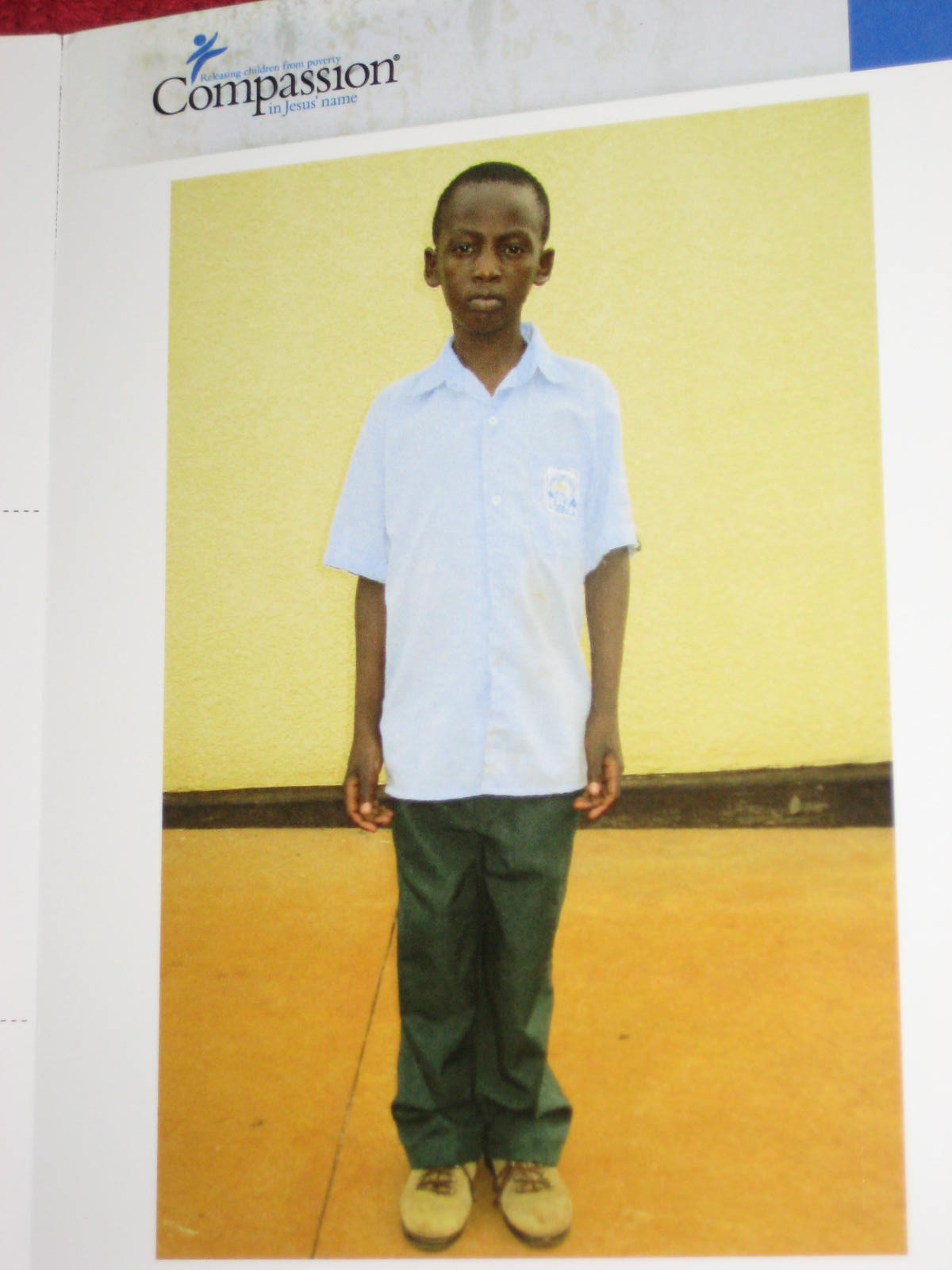
Meet our first “son,” Shimwamana Emmanuel. He’s 10 years old, and lives in Rwanda. We’ve sponsored Shimwamana through Compassion for almost two years now, and have had his picture posted on our refrigerator, where we are reminded to pray for him daily. Today, we were excited to receive a brand new picture of him. Clearly he’s grown, and the baby-faced little boy is now becoming a young man. We’ve enjoyed exchanging letters with Shimwamana, and knowing that he is being nurtured physically, mentally, and spiritually. I can’t wait for his younger brother and sister to meet him someday.

What does $38 a month in the life of a child do? Does and investment of a little over a dollar a day make a difference? I had always wondered, until I watched this video. I know the video is a bit long, but please don’t just skip over it. I promise it’s worth the investment of time. If you are like me, your life will never be the same.

 A word of caution: have some tissues available.

This is what sponsoring a child can do: forever change the course of a child’s life, break the cycle of poverty, and make a difference for eternity. Not everyone is called to adopt as we are, but I do believe that everyone is called to the cause of the fatherless.

Our Pastor asked us several years ago to consider the question, “What are you willing to give up so that an orphan might live?”  That question, coupled with this video, profoundly changed our lives. We believe it has profoundly changed Shimwamana’s life.

And we hope to change the lives of two more children soon! Thank you for being part of our journey!

Beginnings of Life and Love

Tomorrow’s lecture, in the Medical Ethics class that Ken and I are co-teaching, discusses beginning-of-life issues, which are exceedingly complex. To examine the technicalities of the events of conception compared with the ethical and theological issues of original genetic material is dizzying. To acknowledge that life begins at conception is a given for most, but the more intriguing and difficult question is when does biology encounter the eternal?

  • When does God impart the soul?
  • If life begins and the soul is imparted at conception, do identical twins share a soul?
  • If the soul leaving the body and cessation of brain activity defines death, how to we conversely define life?

 These questions are not so easy to answer, but the answers have terribly important implications– not only for the issue of abortion, but for stem cell research, and even contraception.

I’ve always been pro-life. I’ve even worked at a Crisis Pregnancy Center. But even within the pro-life movement, there are many different beliefs and definitions. That doesn’t even include the pro-choice side of the debate. The sanctity of life has been debated for nearly 40 years now, and the end of the dispute is nowhere in sight.

During adult Bible study last night, the issue of abortion came up as we were discussing the role of politics in the life of a Christian. Ken pointed out that when Mother Teresa visited the United States, and spoke at the National Prayer Breakfast, she cut to the issue of abortion when she said of unwanted fetuses, “Please don’t kill the child. I want the child. Please give me the child. I am willing to accept any child who would be aborted.” Rather than casting out caustic words of judgment, she simply answered the question of what to do with unwanted children with open arms and with a heart of love.

For me, at the heart of the pro-life movement is a connection to adoption– adoption of infants, adoption of children from other countries, adoption from foster care. I believe that life is precious. I believe that every child deserves a forever family, regardless of how old they are, what country they live in, or how much it costs to unite them with a family. I believe that God loves each of the children of the world every bit as much as He loves you and me. And I believe that orphanages break His heart.

God, help me to see the things that break your heart, and react not with judgment or harsh words, but with open arms and a heart of love.

Gettin’ Chikin’ for Adoptin’

On four Wednesdays in August, Chick Fil A is going to allow us to keep a portion of the proceeds made from sales from our friends who eat at Chick Fil A from 5:00 to 9:00 p.m.! Perfect timing for heading to or from church! You can eat in the dining area, or get food in drive through!

The more friends who participate, the greater percentage of sales we’ll receive to help us in our adoption from the Democratic Republic of Congo.

The dates are:

August 10th, 17th, 24th, and 31st at the HERMITAGE Chick Fil A.  


In order for us to get credit for your purchase, you’ll need to put your receipt in a basket at the front counter.


We drive past at least a dozen other restaurants to go to Chick Fil A, usually at least once per week. Why do we love Chick Fil A? Let me count the ways:

  1. Your food is delicious. Always.
  2. Your customer service is not only quick, but accurate, and pleasant.
  3. You offer me several choices of diet beverages, and I enjoy them all!
  4. Your restrooms are clean.
  5. Your employees offer to take my tray, bring me refills, or offer me mints. In short, I feel like you want me there.
  6. I’ve never heard a former employee say anything but great things about working in your restaurant, and they continue to eat there too.
  7. You’re quick to make your customers happy – whether it’s giving kids ice cream instead of toys with their kid’s meals, giving extra dipping sauce, or handing out coupons.
  8. You invest significant money into foster children, college students, marriages, and Christian leadership principles. All things that I care deeply about as well.
  9. Your corporate purpose is: “To glorify God by being a faithful steward of all that is entrusted to our care,” reminding us that we can glorify God, no matter what our vocation.

But you know why I love you most, Chick Fil A?

You’re going to help us raise money for adoption!  

Would you consider Gettin’ Chikin’ for Adoptin’ those nights? Would you help us bring our children home?

Oh Happy Eating!

Ken and I spent a fun afternoon chasing down our newest-to-us food truck. Fortunately, we didn’t have far to go. Happy Eating was parked out in front of Happy Japan on Bransford Avenue in Berry Hill.

We don’t consider ourselves well-versed in Japanese cuisine, other than sushi, but we were willing to try some new flavors and foods. Happy Eating was a great choice for Japanese-inspired fusion cuisine.

At first the menu looked a little bland, until we saw the specials of the day. The Hiro Tacos immediately caught my eye: terrayaki chicken with asian slaw, rice and a side of grilled pineapple. And sweet potato curry fries with a side of wasabi mayo? Yes please! Ken chose BBQ steam buns, gyoza (vegetable-filled dumplings), and another order of sweet potato curry fries.

The hero of the meal was definitely the Hiro Tacos. Great Japanese flavors in a crispy taco-shaped wonton shell was music to my happy tastebuds. The sweet potato fries had a great sweet heat — especially with the wasabi mayo. Ken’s BBQ rolls were light and delicious, and the gyoza was very good as well, especially the sauce, which I’m fairly certain I could drink a whole bowl of.

The most fun part was the soda. I got a Japanese strawberry soda and Ken got “lychee” flavored soda. When we asked what lychee flavor was, the vendor explained it tasted like what would happen if a grape and a peach got married and had a little baby fruit. If for nothing but to support a blended family, Ken had to try it. Both sodas were delicious, but the best part was trying to open them! We had to peel off the wrapper, pop off the top, push the center of the top out, and then plunge it into the top of the bottle to dislodge a marble, which then allowed us to drink. This is clear evidence that the Japanese must be highly educated — otherwise they would always be thirsty!

This slideshow requires JavaScript.

Overall, we LOVED our Happy Eating experience! The food was great, the service was awesome, and even outdoor dining was tolerable in the shade. When we mentioned that we were from the Donelson-Hermitage area, they said that they regularly get asked to come to Hermitage, but aren’t sure where to park the truck. They were completely open to suggestions! Hermitage peeps, would you be interested in getting some food truck traffic? Where would be a good place for them to park? Does anyone want to join us for our next food truck adventure?

Hope Is On The Way

I’ve watched this video many times — looking for their faces, inspecting the facilities, searching for smiles. This is where the children I hope to bring home soon are living.

I wonder:

Do they know that we’re coming?

Are they afraid?

Are they losing hope that no one will ever come for them?

Do they know that we love them — even though we’ve never met?

Do they know that we have every detail of their pictures memorized, right down to the stains on their shirts and the braids in their hair? 

Do they know that we’re working hard to bring them home as fast as we can?


God, keep these children safe — all of them who are waiting for their forever families.  

But could you whisper to those who will belong to us? Hope is on the way.

Lamentations 3: 21-26, NIV

Yet this I call to mind
   and therefore I have hope:

 Because of the LORD’s great love we are not consumed,
   for his compassions never fail.
They are new every morning;
   great is your faithfulness.
I say to myself, “The LORD is my portion;
   therefore I will wait for him.”

 The LORD is good to those whose hope is in him,
   to the one who seeks him; 
it is good to wait quietly
   for the salvation of the LORD.

Adoption Is Our Plan A

Last week, I had to renew my adoption physical, so I was back to see my wonderful physician. This was not the first . . . or even the third time I had seen her in the last year for something adoption-related. When I told her of our recent frustrations and joys with adoption, she was very candid with me about her own struggles with infertility, and how when she was patient, God allowed her to conceive. Though she had considered adoption, she was so thankful that God had blessed her by being able to give birth to her own children. She talked to me some about local infertility specialists, and she encouraged me not to give up hope of conceiving and to know that God had a plan.

Over the last year as we’ve talked about adoption with friends, many have told us stories of surprise conceptions after submitting adoption paperwork, or made statements of sympathy regarding our infertility. While I so appreciated stories of inspiration, and feelings of empathy, I have to be honest. Our adoption has nothing to do with infertility. For us, adoption is not a plan B.

Adoption is our plan A.

While it may be difficult for others to understand, to me it has been clear since I was a child: I was to leave my home open, so that when the time was right, we could open it to a child or children in need. Sure, it’s taken us a long time to finish our education and find stable employment to create a good atmosphere for having children, but we eventually arrived at the point where we were ready to start building our family — through adoption.

I find the cause of the fatherless to be echoed throughout Scripture — that we are to care for foreigners, orphans, and widows and that turning away from them bears serious consequences. A passage that has consistently inspired us has been in James 1:22-27, NIV.

Do not merely listen to the word, and so deceive yourselves. Do what it says.  Anyone who listens to the word but does not do what it says is like someone who looks at his face in a mirror and, after looking at himself, goes away and immediately forgets what he looks like. But whoever looks intently into the perfect law that gives freedom, and continues in it—not forgetting what they have heard, but doing it—they will be blessed in what they do.

 Those who consider themselves religious and yet do not keep a tight rein on their tongues deceive themselves, and their religion is worthless. Religion that God our Father accepts as pure and faultless is this: to look after orphans and widows in their distress and to keep oneself from being polluted by the world.”

We cannot read the consistent theme of caring for orphans that is present throughout the Bible and then turn away as if we havn’t read it. Scripture has been clear, and my calling since childhood has been clear. Making room for orphans in our home is God’s mandate to care for others in the same way He has cared for us.

Recently, a book I’ve been reading confirmed some the same sentiments that I’ve been feeling.

“We look back on slave-owning churchgoers of 150 years ago and ask, ‘How could they have treated their fellow human beings that way?’ I wonder if followers of Christ 150 years from now will look back at Christians in America today and ask, ‘How could they live in such big houses? How could they drive such nice cars and wear such nice clothes? How could they live in such affluence while thousands of children were dying because they didn’t have food and water? How could they go on with their lives as though the billions of poor didn’t even exist?'” — David Platt, in Radical

I’m glad I was able to explain to my physician that our plan to adopt was our first choice. She didn’t need to feel bad or refer me to a specialist. In a sense, God Himself is our fertility specialist. We are expecting children — children on the other side of the world whom God is preparing to bring into our lives at His designated delivery date.

And we couldn’t be more excited about our Plan A.

Brewing Something Good

When Ken was in his MBA program, he had to do an in-depth economic project on a industry of his choice. He looked no further than our kitchen for inspiration: the coffee industry. Coffee is the second most highly traded commodity in the world, second only to oil. The United States is the world’s largest consumer, drinking 1/5 of the world’s coffee. Unfortunately, prices that are paid to the local coffee farmer are often not a livable wage, and in some cases, do not even cover the costs of production. It sounds an awful lot like slavery, doesn’t it? All so I can have a cup of coffee in the morning.
 
If farmers aren’t paid a livable wage, their children are more likely to receive a poor education — if they get an education at all, because they are required to work in the fields. The health of the family is at increased risk. The cycle of poverty cannot be broken.
 
While I pride myself on being frugal, God began to convict me of stealing profits from farmers in third world countries. While I like to save a dollar as much as the next person, I was saving money at the expense of those who needed the money much more desperately than I did. My purchasing habits perpetuated the cycle of poverty. My spending habits were leading to more orphans in the world.
 
In 2008, Ken and I decided that we needed to be more socially conscious with our purchases, starting with coffee. We decided to buy Fair Trade coffee, which is purchased with as few intermediaries as possible, to keep profits in the pockets of the farmer and in the farmer’s community. The Fair Trade label ensures that farmers are paid a local competitive wage, that the farmers use environmentally sustainable practices, and there is a required investment in community development. Schools are built. Clinics are established. Families stay together.  And we get coffee that is second to none.
 
The most surprising thing about Fair Trade coffee is that it typically costs NO MORE than comparable quality commercial coffee. The bags sit next to other bags of coffee, but bear this label:
 

No, you won’t find Fair Trade coffee in the large bargain-priced cannisters, but you will find it if you look for it. Most grocery stores now carry at least one Fair Trade line of coffee.

Our support fair treatment of coffee farmers around the world is one reason why we’ve chosen to raise money for our adoption through Just Love Coffee. Their organization roasts coffee to be sold for the purpose of supporting an Ethiopian orphanage. They also have a wide variety of fair trade coffee. Plus we receive $5 per bag to support our adoption.  
 
So each bag purchased helps to support:
  • farmers, so they can earn a fair wage in order to support their families,
  • an Ethiopian orphange,
  • and us!

Who knew one bag of coffee could make a difference in the lives of so many?

Will your next cup of coffee make a difference? One way or another, I believe it will.