Counting Sheep

A guest post by Ken

My absolute earliest memory of church is sleeping on my mom’s lap during a choir performance. Apparently, I had been dressed up like a little lamb. The song the choir was singing was based on the parable of the shepherd leaving the ninety-nine to find the one lost sheep (Luke 15). The shepherd wandered up and down the aisles of that school auditorium (the Saint John First Wesleyan Church was still under construction) until he “discovered” me. It’s safe to say I was adorable.

As a Christian, I freely admit that I have been that lost sheep. I have wandered far from the safety of the fold. I have been lost and afraid in dark and dangerous places and wondered if I would ever find my way back home.

Because Jesus has rescued me and called me His own, I now feel compelled to share His love. I want to be part of His mission. I want to be a shepherd as well. I want to reach out with God’s love and change my world. The words of James, the brother of Jesus, ring in my ears, “Do not merely listen to the word, and so deceive yourselves. Do what it says.” (James 1:22) It’s not enough for me to SAY that I want to help other people. I actually want to make a lasting difference. Not for my sake, but for God’s glory.

This summer I watched and prayed for a number of college students from our church as they set out to share God’s love in Europe. I am so proud of them for the boldness and compassion they displayed. Another group, also from our church, prepares even now for next summer and their trip to Kenya. Again, I pray and support them whole-heartedly. They are going to Africa to partner with what God is doing there through World’s Servants.

Lord willing, some time this winter Robin and I will set out on our own very unique mission trip. We want to be like Jesus and go to where the hurting and hunger is great. We are convinced that if Jesus were walking the earth today, He would go and do whatever He could to help end the suffering.

People have asked me if it’s safe for us to travel to the Democratic Republic of Congo. I respond, “No! It’s not. That’s why we are going. Our children are there and we want to bring them home.” I wish that it were safe or easy or cheap. But it is none of those things. Yes, there have been stumbles and setbacks along the way. Frustrations and tears. Yet none of those things release us from what we believe God is calling us to do.

We believe God is calling us to leave the comfort and safety of our middle class suburban lives: to join with Him. And to rescue two children who need a permanent roof over their heads, food on the table, clothes on their back, and perhaps most of all a mother and a father who will tuck them in bed at night and tell them about the Good Shepherd who loves them more than they can ever imagine.

A Successful Journey

I used to have a small plaque in my bathroom, back in my bachelorette days, that had gold calligraphied  letters on a black background that read, “And we know that in all things God works for the good of those who love him, who have been called according to his purpose. Romans 8:28”

What an inspiring verse! God is personally looking out for me! Really, when looking to have someone to work toward your good, God should definitely be at the top of the list. And of course I would let God know what exactly was best for me, and I was happy when He would give it to me.

Except that wasn’t very often.

And over the years, it began to irritate me. It seemed like God wasn’t listening to me, or even to my friends and loved ones. I had an extended illness and was laid off at work. A friend lost his infant daughter and was paralyzed in an accident not long after. A boy in our dorm was killed in a car collision as he was moving in for the semester. A friend lost a long battle with a chronic illness when he was much too young.

God? How are these things for the best?

C.S. Lewis once said tongue-in-cheek, “We’re not necessarily doubting that God will do the best for us; we are wondering how painful the best will turn out to be.” 

Even now, I tell myself that just because we lost our referral, just because there were no twins to adopt, just because adoption through foster care was not what we thought it would be — it’s all because God has other children waiting somewhere else to complete our family.

But what if there aren’t?

Oswald Chambers in My Utmost for His Highest points out that God’s definition of success is not necessarily the same as ours,

“We tend to think that if Jesus Christ compels us to do something and we are obedient to Him, He will lead us to great success. We should never have the thought that our dreams of success are God’s purpose for us. In fact, His purpose may be exactly the opposite.”  

So I have to ask myself: What if He doesn’t have children for us to adopt?  What if this entire process is not about adopting children but about me learning to trust Him with our future family?

“What we see as only the process of reaching a particular end, God sees as the goal itself. What is my vision of God’s purpose for me? Whatever it may be, His purpose is for me to depend on Him and on His power now. If I can stay calm, faithful, and unconfused while in the middle of the turmoil of life, the goal of the purpose of God is being accomplished in me. God is not working toward a particular finish— His purpose is the process itself.”

 Truthfully, I am realizing that the point of our adoption journey is not merely the children who will complete our family. The point of our adoption journey is every bit as much about what God is doing in my heart along the way.

Maybe even what He is doing in your heart as you walk beside us.

Do I believe and hope that there are children at the end of our adoption journey? Absolutely. But even if there are no children at the end of the road, a God-directed journey is still worth every step along the way.

Ms. Grateful

Last night, Ken and I had the opportunity to spend some time volunteering at a nursing home on the other side of town. It was a unique opportunity to play bingo alongside some of the disabled and elderly residents who live there.

Ken and I were responsible for different tables of residents, so of course we had to make it a competition to see whose table could win the most. He won.

I had the chance to play alongside some really wonderful people. One was actually a familiar friend I know from volunteer work I do at Mercury Courts, a housing development just down the road from Trevecca. I couldn’t believe he was there — and he told me he had just arrived that very day. It was a pleasant surprise for both of us.  Another lovely lady, “Shorty” went to high school with my Mercury Court friend, so they had a nice reunion at our table. Another gentleman at my table could make a joke or a rhyme out of anything. His body may have been failing him, but his mind was sharp as a tack. We laughed together, hard. The lady I spent the most time with was Ms. Grateful. After every Bingo number called, she would shout out, “Thank you,” whether she had the number or not. I would help her watch for the correct numbers, and as I helped her identify them, she thanked me too.

 The social director told me that she was the most grateful resident they had.

Ms. Grateful couldn’t say much else — not that I could understand anyway. Her body was confined to a wheelchair, her gnarled hands had trouble moving the bingo chips, saliva gently dripped down her chin. Her stained shirt was a visible reminder that even basic tasks were a challenge to her.

But she was the most grateful resident that they had. She had a roof over her head, a place to sleep, food to eat. And she had a friend to play Bingo with, and even someone to call the numbers. She even won. Twice.

Isn’t that enough to be grateful for? Sometimes we make gratitude too complicated, withholding a thankful heart until something “big” comes along, when all along there are little blessings sitting all around us just waiting to be acknowledged and appreciated.  Ms. Grateful’s simple approach was this: Rather than looking at the things she didn’t have, she was thankful for everything she did have, right down to the Bingo caller at the front of the room.

When I took Ms. Grateful back to her floor, I thanked her for showing me a wonderful time as I touched her arm gently, and said good-bye to her now tearful face. She took my hand in both of hers, and softly kissed it. “Thank you,” she said one last time.

No, thank you, Ms. Grateful.  Truthfully, I am the one who won.

“Blessed are the pure in heart, for they will see God.” Matthew 5:8, NIV

The Changing Cloak

I had lunch with a dear friend today, and as we chatted, one of the topics that came up was the return to new normalcy after an intense time of grief, which both of us have experienced in the past few months.

To be a joyful person enshrouded by grief is difficult. The cloak of grief placed unwillingly on a happy heart is a difficult and unwelcome experience. The laughter that once was freely flowing seems to offend the garment, to betray that which was lost, to deny the devastation of the heart.

Yet, the garment of grief doesn’t fit right – binding in some areas, saggy in others, always dragging the ground. The burlaped texture of gristly grief chafes my already thin skin. The overwhelming weight is wearisome.

There have been times that I have thought that I was becoming accustomed the shroud, only to realize that its presence was clearly felt on my shoulders again. Getting a new bill in the mail for the adoption that never existed. Being asked by a friend unacquainted with our situation, “How are the twins?” Finding tiny baby items that I tucked away for the future — a future that will never come.  

But I do not have a choice of apparel. The cloak must be worn dutifully, and eventually, worn submissively.

Over time, I have found that the misshapen shroud of grief has transformed. I’ve tucked it in on one side, tied it on the other to better fit my soul. The once-abrasive fibers have softened. My skin has thickened as well. The heaviness is still present, but rather than being oppressive, if I consider it, it is now feels much more like warmth.

Could it be that the shroud of grief has become a cloak of God’s consolation? Could it be that the garment that I once resisted is the very means of grace by which God has chosen to demonstrate the closeness of His comfort?

Perhaps this is what Jesus spoke of in the Beatitudes, when He said, “You’re blessed when you feel you’ve lost what is most dear to you. Only then can you be embraced by the One most dear to you.” Matthew 5:4, The Message

It may not be that the cloak itself has been transformed nearly as much as the cloak has transformed me. Now laughter does not betray comfort. Joy does not deny the embrace of the Almighty. Smiles are an expression of love, not a betrayal of such. Though my life has been forever changed by the donning of the cloak, I’ve come to realize that it is not an instrument of hardship as much as it is a demonstration of love.

Unsafe in His Hands

Along our adoption journey, we have been asked many questions about our process and about where we are going to go get our children. The Democratic Republic of Congo has just recently opened to international adoption, and in fact, up until May of this year, parents were urged not to go there to get their children, but to have them escorted back to the United States because of safety concerns.

Is traveling to the Democratic Republic of Congo dangerous? Absolutely.  And that’s exactly why we must go. Orphans whom we were called to adopt are there, and it’s an even more dangerous place for them.

The truth is, our adoption journey has not been a safe one even thus far. We have been hurt. We have been robbed. We have been shamed. But we have not lost sight of the fact that every step of our adoption journey has been ordained by God.

Nevertheless, God does not lead us to safe places. David Platt, in his book Radical says,

“[God] is good. He is good even when he calls you and me to places that are dirty and disease ridden. He is good even when we end up possibly sharing in the diseases of the people we go to serve.” The diseases aren’t just AIDS or malaria or hepatitis. The diseases of some along our adoption journey have been lying, deceit, incompetence, and fraud. But that does not mean that the calling was a mistake, that our actions were in error, or that God allowed us to go down a wrong path.

Following God’s will isn’t safe. When you are doing the work of the kingdom as you follow Him, it will certainly lead you to dangerous situations. It wasn’t safe for Jesus. It wasn’t safe for His disciples, or the early Church. Why should it be safe now? David Platt writes, “To everyone wanting a safe, untroubled, comfortable life free from danger, stay away from Jesus. The danger in our lives will always increase to the depth of our relationship with Christ.”

 If we only attempt to do what is possible on our own, are we really following anyone but ourselves?

True followers of Christ attempt to do things that would be impossible without God. And that’s what He has called us to do.

We are to go into dangerous places in the world and seek out waiting orphans who have seen many other children leave the orphanage, wondering when it will be their turn, questioning if they will ever be chosen to be a part of a forever family.

We are adopting children from a different race, language, and culture. This too is dangerous, and we know the risks of developmental difficulties, trouble with bonding, and lack of societal acceptance.

We don’t know how we will pay the costs of the adoption. $28,000 is a lot of money to raise in 6 months, and as much as we plan, it will be impossible without Divine intervention. Adopting two orphans half way around the world is financially dangerous.

But our security is not in our physical safety. Neither is it in our bank accounts, jobs, or material possessions.  Our security is not in what others think of us, or even in a culturally accepted family structure.

David Platt again writes in Radical, “Indeed, God knows every detail of our lives, and when we step out in faith to follow Him, He will show us that our greatest security is not found in the comforts we can manufacture in this world but in the faithful provision of the only one who knows our needs and the only one who is able to meet our needs in every way.”

God has called us to dangerous places, and that’s exactly where our greatest safety is found.

Our Oldest Son

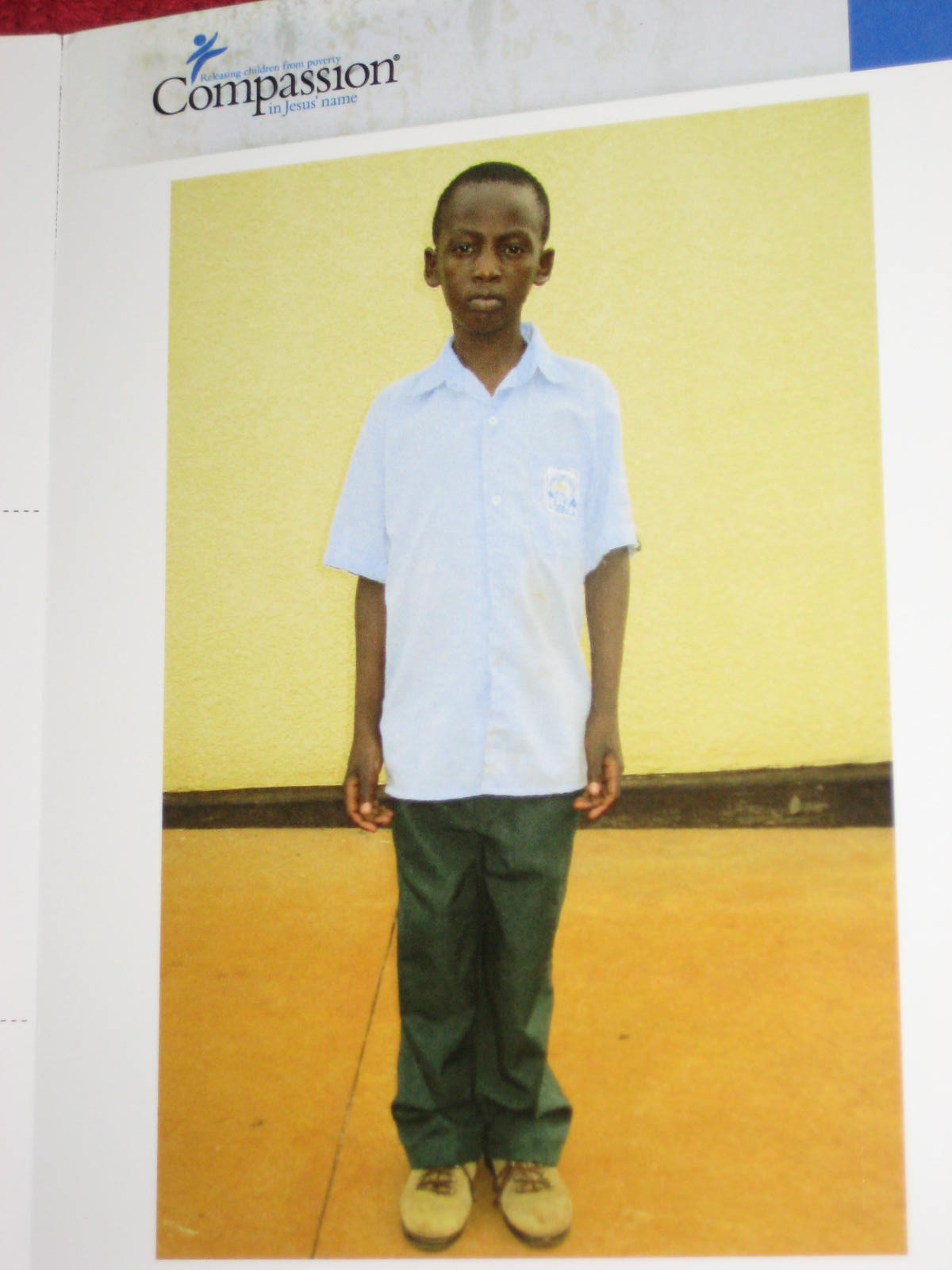
Meet our first “son,” Shimwamana Emmanuel. He’s 10 years old, and lives in Rwanda. We’ve sponsored Shimwamana through Compassion for almost two years now, and have had his picture posted on our refrigerator, where we are reminded to pray for him daily. Today, we were excited to receive a brand new picture of him. Clearly he’s grown, and the baby-faced little boy is now becoming a young man. We’ve enjoyed exchanging letters with Shimwamana, and knowing that he is being nurtured physically, mentally, and spiritually. I can’t wait for his younger brother and sister to meet him someday.

What does $38 a month in the life of a child do? Does and investment of a little over a dollar a day make a difference? I had always wondered, until I watched this video. I know the video is a bit long, but please don’t just skip over it. I promise it’s worth the investment of time. If you are like me, your life will never be the same.

 A word of caution: have some tissues available.

This is what sponsoring a child can do: forever change the course of a child’s life, break the cycle of poverty, and make a difference for eternity. Not everyone is called to adopt as we are, but I do believe that everyone is called to the cause of the fatherless.

Our Pastor asked us several years ago to consider the question, “What are you willing to give up so that an orphan might live?”  That question, coupled with this video, profoundly changed our lives. We believe it has profoundly changed Shimwamana’s life.

And we hope to change the lives of two more children soon! Thank you for being part of our journey!

Belly Up On a Bare Floor

Five years ago, we had just moved into our house in Donelson from the dorm at Trevecca. We had two wild-as-bucks lab puppies, I was working in dermatology, and Ken had just finished his Master’s in Business Administration. Everyone had always told us that an MBA was the ticket to a six-figure salary, and that he would never have trouble finding a job — not that he had ever had trouble with that. Until that summer.

I wrote the following in July of 2006 . . .

——————————————————————————————————————–

Just before the puppies came to us, I asked you all for puppy advice.

The Gaffords offered this:

I can’t really think of any particular products to recommend, but one of the best things we did for Allie was to teach her submission. We did this several times a day (especially if she was getting too wild, etc.). All you do is flip the pup over on his/her back (either on the floor/ground or in your lap) and hold him/her down with your hand. The idea is to not let them get up until they’ve relaxed. They learn to trust you this way. This has also come in handy as we’ve needed to trim nails or do ear drops, etc. If you teach it to them when they’re puppies, it will make it a lot easier later on.

It was great advice, and our vet reinforced the same principle. Hold them down, belly up, until they relax. Submission. Trust.

That’s how I’m actually feeling in our life right now. Ken is still looking for a job. When he didn’t get the job we thought was his in February – a dream job coordinating a team to create and write young adult ministry material – we were assured by family and friends, “That’s because God surely has something better planned.”

Yet here we wait. Ken is done as RD. Other dream jobs that we thought were his have come and gone. We are no further along in the job search process than we were a month ago. In fact, we’re further behind.

And maybe God does have some spectacular job waiting around the corner. Perhaps someone will call him tomorrow and offer Ken a job that takes into account his experience and education as well as his talents and social skills.

But for now, I feel like one of the puppies, held down on my back. Learning to trust. Trying to relax.

The truth is, when I turn the puppies over, sometimes I have no reason other than to teach them to trust me. To learn submission. Sometimes it is to give them a belly rub or clean their paws. But I also sometimes just have to hold them down to teach them to rest, even while they are uncomfortable.

I think too often we try to rationalize God’s behavior, demanding that everything work out to make sense –wanting there to be a reason for being forced to wait and hold still. Expecting, almost demanding, for there to be a good reason for the forced submission. We expect that God will always have something better around the corner when He lets us up.

And He very well may. Yet insisting that God answer me in a way that I think makes sense or provide something better means that I’m not really allowing God to be God. Part of allowing God to be God to me is letting Him hold me down, forcing me to wait, forcing me to trust.

Yes, forcing me to submit.

And sometimes for no other reason than for me to recognize that He is God, and I am not.

There may be something wonderful around the corner, or there may be more waiting, or there may be something that isn’t what we had hoped for.

All is not lost. I don’t despair. I can trust that He is good. Whether Ken gets a job of his dreams that now seems out of reach, or stays at home as a full-time puppy wrangler, or stocks shelves, God is still good. I can choose to be angry at God for holding me down, or I can relax in His arms, knowing that whether this time will end the way I hope, or the way I fear, He is still good.

So as I feel like a puppy lying belly up on a bare floor, I’m learning to relax in the hand of the One who is good, no matter what circumstances may come.

__________________________________________________

Indeed, there was more waiting to come. It was an additional year before Ken started his job at our current church, and only at 1/4 time. It wasn’t until 18 months after that when he finally went full-time.  Whether the delay was about understanding submission, realizing God’s goodness in spite of circumstances, or figuring out God’s plans are not about me but about Him, there were lessons to be learned along the way.

Time waiting is never wasted.

Stepping Away From Worry

A few weeks ago in college Sunday School, we discussed the article, “Do Women Sin?” by Keith Drury. Now before you think that we’re a bunch of heretics, the answer was that yes indeed, women do sin. It’s just that the types of sin committed by men versus women tend to be of a different sort. The students in the article noted that men struggle more with lust, pride, anger, etc. while women struggle with, um . . .

What was it again that the article talked about?

Oh yes, the sins that women struggled with, which the students mentioned in the article were, “lack of self-esteem,” and “lack of trust.” We all had a good laugh over the fact that the biggest problem women have is that they don’t think highly enough of themselves!

But on a more serious note, we talked about how poor self-esteem and worry really can lead to other sins. “They’re like gateway sins,” one of the students quipped. Worry may or may not be a sin in and of itself, but it can easily develop into other sins. Do we really need to take worry seriously?  Even if worry is a sin, we certainly don’t treat worry like we do other, more external sins.

To be honest, there is much worry potential when it comes to this adoption. How long will it take? Can we raise the money? Are the children safe? Do they know that there are people on the other side of the world who love them and are desperately trying to bring them home? Will our travels be safe? Will I be able to avoid eating foods I’m allergic to in a country where I can’t necessarily identify what I’m eating?  Will the children be able to adapt to American culture? How is it that I’m going to be the only one in our house who doesn’t speak French? How will we ever make up for the time that we’ve already spent apart? Will they love me in return?

A couple of days ago, I was reading the My Utmost for His Highest devotional for the day, “One of God’s Great Don’ts,” in which Oswald Chambers talks about worry when he states, “We tend to think that a little anxiety and worry are simply an indication of how wise we really are, yet it is actually a much better indication of just how wicked we are.”

Ouch.

Yet his words continue to fillet my heart open, “All our fretting and worrying is caused by planning without God.”

The truth is, it’s easy to worry when we don’t have a strong sense of direction from God, and for me, even when I do. We know that God has directed our footsteps precisely every step of the way along this journey — even the painful steps.

However, it’s those potential painful steps that cause me the most worry. We’ve seen so much disappointment along the way. I don’t know that things are going to go smoothly as planned. Though I certainly hope, I don’t know if this adoption path will lead us to our happy ending.

But I know and trust the One who created the path to begin with. I trust that He is good. And I refuse to worry, because worry places my desires for myself ahead of my desire for Him.

Resting in the Lord is not dependent on your external circumstances at all,

but on your relationship with God Himself.”

 — Oswald Chambers, My Utmost for His Highest.

Good Grief

We could not believe that we had been so deceived.

After months of preparation for adoption, first through foster care, and then from a birth mother who had approached us at church, we were within days of our twins being born. Only there were no twins. There were no babies at all. The birth mother was not even pregnant. We had been robbed, deceived, heartbroken.

Grief. The dark hole of the soul that seems to have no limits to its depth.  My plans, my dreams, my joys, were ripped out from under me and my heart tumbled in a free fall into the murky pit of grief.

I mourned the children that never were. Though they had names, they had never existed. How do you grieve someone who never existed?

I grieved motherhood. For years I had prayed that God would make me a mother, and I had believed that I was at last realizing that dream, only to have that dream snatched away.

I mourned my plans. My plans were to spend the first half of the summer devoted to being home. Though I knew the crazy schedules and sleeplessness would be exhausting, those disruptions were desired and loved. Now, I would have to take on a tremendous load of work — my regular course load, plus my course load that was meant for me when I worked my way back from maternity leave.

I grieved all the baby things waiting in new packaging that we would never open. The letters spelling Palmer and Emelia crafted with such love that would never be hung on the wall. The mural that would never light up two pairs of tiny eyes. The matching outfits that would never elicit the question from strangers: Are they twins?

I mourned the excitement of others, who were also waiting with bated breath for the twins’ arrival as they asked, “Any news about the babies?” Their hopes would be dashed as well, as soon as I could choke out the words to tell them.

But in the suffocating downward spiral of grief, we were not alone.  In the midst of the mourning, there was never a moment in which I felt that God was anywhere but right there in that endless pit of grief with me. In the darkest nights of sorrow, there was never an hour that I doubted that we were exactly where God wanted us to be. 

For a while, I pondered what purpose God had behind the situation. Perhaps we would be able to prevent the “birth mother” from defrauding someone else. Perhaps our story would serve as a warning to others who were considering independent adoption. Maybe God was delaying our adoption until our actual children were ready. Perhaps God was increasing our dependence on Him.

Any of these were possible, but the truth is that God does not answer to me. The point of surrendering my life to God is not so that He can help me fulfill my dreams, or achieve my goals, or even make me a mother. The point of surrendering my life is to glorify God, even if I must glorify Him in the midst of mourning. 

I would rather be falling into a dark pit of grief, knowing that I am in the center of God’s will, than be living my dreams without God as the center of it all.

Even in grief, God is good.

Good grief.