Growing House Help?

When our house was built, in the early 1950’s, it was average-sized. In fact, in 1950, the average size house was 983 square feet. Over the next 50 years, the size of the average American house grew by 140% to over 2300 square feet.

What happened?

Families got smaller. Houses got bigger. Why?

We love our 1950’s house. Sure, it’s smaller than average, but we have fantastic neighbors and a nice-sized backyard. We have an unfinished basement for storage, laundry, and the ever-important tornado shelter.

Still, the upstairs of our house is small. Three small bedrooms. We’re going to add 2 kids’ toys, bikes, stuffed animals, and blankies. We’re going to double the number of people in the same-sized house.  But my biggest concern is that we have only one bathroom. And we’re about to add 2 more little people to the bathroom schedule. I know it must be possible.

After all, that’s what life was like in the 1950’s . . . I think.

So, did you ever live in a small house? What suggestions do you have for a growing family in a small house?

Leaving the Orphanage

On an otherwise ordinary day, sometime in the next year, two foreigners will arrive at a place where dozens of children call home.

The foreigners don’t look the same as everyone else. Their skin is different. Their hair is different. Their clothing is different. They even talk different.

They have a few gifts: a doll, a toy car, some candy. They share something with all of the children, but it is clear that they are there for only two. A slender shy young boy, and a chubby cheeked little girl, who are brother and sister. They take the boy and girl aside and begin to tell them of a wonderful place. They show them pictures of a brick house with green shutters, and two rambunctious dogs. They show them glimpses of the playground at their church, and pictures of many people with smiling faces.

These foreigners seem nice. They smile. They hug. But they also try to convince the boy and girl that there is a better home — the one in the pictures — that they want to take them to.  They will be leaving everything they know, riding in a big bus that flies in the air to a new continent, a new country, a new home. And they may never return to what they know.

The language barrier is difficult. There are translators, but they don’t seem to be doing an adequate job because the children seem afraid. If only they knew what was waiting for them on the other side of the world, they would never hesitate to leave their home, their orphanage.

Will the orphans ever trust the foreigners enough to leave their orphanage behind?

Over 2000 years ago, a foreigner came to earth. He looked different. He talked differently. He brought with Him small glimpses of the home where He had come from: miracles of healing, wholeness, fullness. But the miracles were merely representations of the place from which He had come, not the destination itself.

In fact, He has come to adopt us, to set us free from our captivity to sin and to give us the freedom and comfort of a son, rather than the imprisonment and rejection of an orphan.

Yet in spite of the glimpses of wholeness and healing that He has brought to the orphanage to demonstrate our real home, the temptation is to remain in the orphanage. The walls have become familiar. What could feel like imprisonment has come to feel more like, well, like . . . home.  

Even if we do leave the orphanage, the temptation to return is powerful, especially when we are challenged to live beyond what is natural to us. After all, it’s hard to believe there is a Kingdom waiting for us when the orphanage is all we have ever known.

“We don’t fully believe that our new Father will feed us, so we hang on to our scraps and long for the regimented schedules of the orphanage from which we’ve come. And when our Father pushes us along to new tastes, we pout that he’s not good to us. But he’s readying us for glory, preparing us to take our place on thrones as heirs.” — Russell Moore in Adopted for Life

We all have been invited out of the orphanage, and into Adoption, but we must decide: Are we willing to leave the orphanage behind?

“It is obvious what kind of life develops out of trying to get your own way all the time: repetitive, loveless, cheap sex; a stinking accumulation of mental and emotional garbage; frenzied and joyless grabs for happiness; trinket gods; magic-show religion; paranoid loneliness; cutthroat competition; all-consuming-yet-never-satisfied wants; a brutal temper; an impotence to love or be loved; divided homes and divided lives; small-minded and lopsided pursuits; the vicious habit of depersonalizing everyone into a rival; uncontrolled and uncontrollable addictions; ugly parodies of community. I could go on.

   This isn’t the first time I have warned you, you know. If you use your freedom this way, you will not inherit God’s kingdom.

 But what happens when we live God’s way? He brings gifts into our lives, much the same way that fruit appears in an orchard—things like affection for others, exuberance about life, serenity. We develop a willingness to stick with things, a sense of compassion in the heart, and a conviction that a basic holiness permeates things and people. We find ourselves involved in loyal commitments, not needing to force our way in life, able to marshal and direct our energies wisely.”

Galatians 5: 19-23, The Message

Dossier Down, and More Waiting to Come

Today, we were able to finish up everything we needed for our dossier, and we mailed it off to our agency. Compared to most countries, the dossier for the DR Congo is pretty straightforward, and we had almost everything on hand. We did have to get a couple of documents notarized (Thanks Willard!), and thanks to our post office’s extended hours, we were able to mail it off this evening.

So, what does this mean? The dossier is the pile of paperwork that begins the adoption process in the DR Congo. From here:

  • Our paperwork will be translated into French by people who know the language, and know the laws of adoption.
  • Our paperwork will be sent to court in the DRC for approval, which can take 2-4+ months. This is one of the places where there’s a big delay right now because of a new judge. Hopefully, things will start picking up soon but with upcoming elections in November, there may be additional delays. I don’t pretend to understand what is going on politically, but there is significant tension about the elections. One agency employee indicated that it’s not uncommon for federal employees to stop working during the time surrounding elections, and there has already been some rioting. Thus, court approval is a big variable.
  • After court approval, there is a 30 day appeal period.
  • The approval is then sent to the Ministry for approval.
  • Once approval is received, we then file again with US Immigration, which takes one to three months.
  • We then request an appointment with the Embassy in the DR Congo for visa processing for the children, which typically takes less than two months.
  • Obtain a letter from Congolese immigration for the children to leave the country, which typically takes less than three weeks.
  • THEN we get to go get the children to bring them home. The trip is usually between 7-14 days. It’s now looking like this will be in the spring, if there aren’t any further delays.

Basically our paperwork is going to ping-pong between DRC and the US, with not much involvement from us. At this point, we’re just in waiting mode. But really, the whole situation has never really been in our hands, but in God’s hands. He knows the process, the judge of our case, the elections coming up, and all of those things that could cause us to worry. We trust God’s timing in all of this, and will look forward to each new step as it comes!

Yeah! and Oh.

We found out yesterday that there have been some delays in the processing of adoptions in the Democratic Republic of Congo. One problem is that some personnel have changed, including a judge who is very new at processing adoptions. Fortunately, he’s willing to learn and has a favorable attitude toward adoption, which is very good news. The other problem with our timeline is likely going to change with the elections in November. The US Embassy has indicated that they expect adoption travel delays, but aren’t sure how long the delays may be. So while we were originally planning to travel by the end of the year, now we’re expected to travel before April. We hope.

The good news is that we received our “Notice of Favorable Determination Concerning Application for Advance Processing of Orphan Petition.” This is the last piece of documentation we need before sending our paperwork to the Democratic Republic of Congo to begin going through their process — the one that’s currently delayed.  We hope to put our dossier together and mail it off by tomorrow!

I don’t know how you do it.

And by “you,” I mean moms who work full-time outside the home, manage a family, volunteer for ministry opportunities, and still keep your sanity.

It’s something that I’m thinking a lot about these days, because I know my days are about to change.

My work plate is filled and spilling over. I love what I do, and I love my students, and this is all fortunate because we can’t afford for me to quit! At the same time, by the time 5:30 rolls around and it’s time for me to head home, I am tired!

Make and dinner, walk the dogs, daily housework chores, find a few moments to read and reflect, work on projects for church and/or our adoption, find a few words to write, and the day is done.

How do I add in two children to the mix? Sports practice, music lessons, homework projects, church activities, creating special memories. My head is spinning with just the thoughts.

So, moms of the world, help me. Okay, even dads too. Give me some words of wisdom.

As a family, how do you balance family with two full-time jobs and church activities?

T-shirt Trial: The Tale of a Frustrated Crafter

Tis the season for t-shirt crafting! Target recently had some of their super-soft scooped neck t-shirts 75% off, and at Big Lots this past week, plain t-shirts were marked down to just 75 cents! 

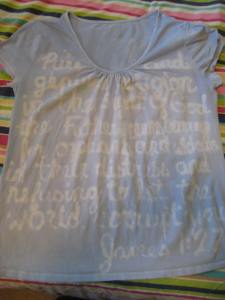
I wanted to create something subtle that didn’t scream “Look at my t-shirt!” but still conveyed the verse that started us on our adoption journey: “Pure and genuine religion in the sight of God the Father means caring for orphans and widows in their distress and refusing to let the world corrupt you.” — James 1:27

I wish I could say that everything went smoothly with this project, but it took two tries, including a step in the middle where I bleached the shirt back to white and started over. I’ll try to be detailed in my instructions so you can avoid the same level of pain, frustration, and stain. Lessons I may or may not have learned will be reflected in italics, ahem.

I started with my Target $2.50 t-shirt, some Elmer’s blue gel glue, and a box of Rit dye. The shirt was originally going to be pink, but when I lifted up this box, it had left blue speckles of dye on my nice white shirt. Blue it is!

Wash the t-shirt, but do not add fabric softener, and let spin dry in the washer. While still wet, place the shirt over a water resistant surface to protect the back from the shirt.  I used the lid of a 5 gallon plastic tote.

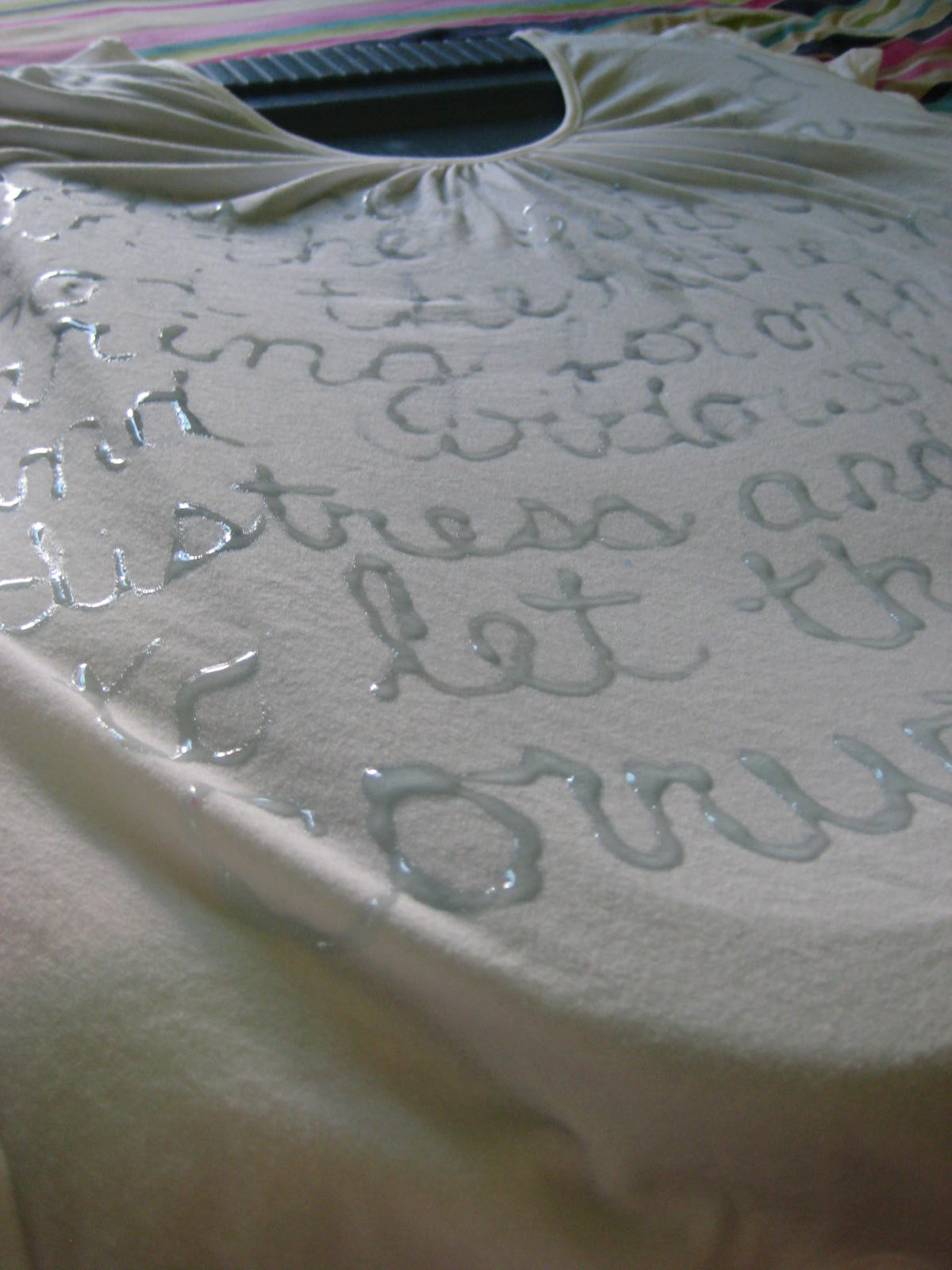
I sketched out a proposed layout of the words, and then followed the basic pattern, more or less, by writing on the t-shirt with the gel glue.

CAREFULLY remove the shirt from the board taking care not to smear the glue and hang to dry, preferably outside. It will take at least 4 hours to dry, or overnight.

Put on clothing that you really don’t care about, or that you’d like to turn into a freckled mess. Mix Rit dye powder in hot water (I used 2 tsp.), then pour into approximately one gallon of cold water. The dye powder needs to dissolve, but you don’t want the glue on the shirt to dissolve.

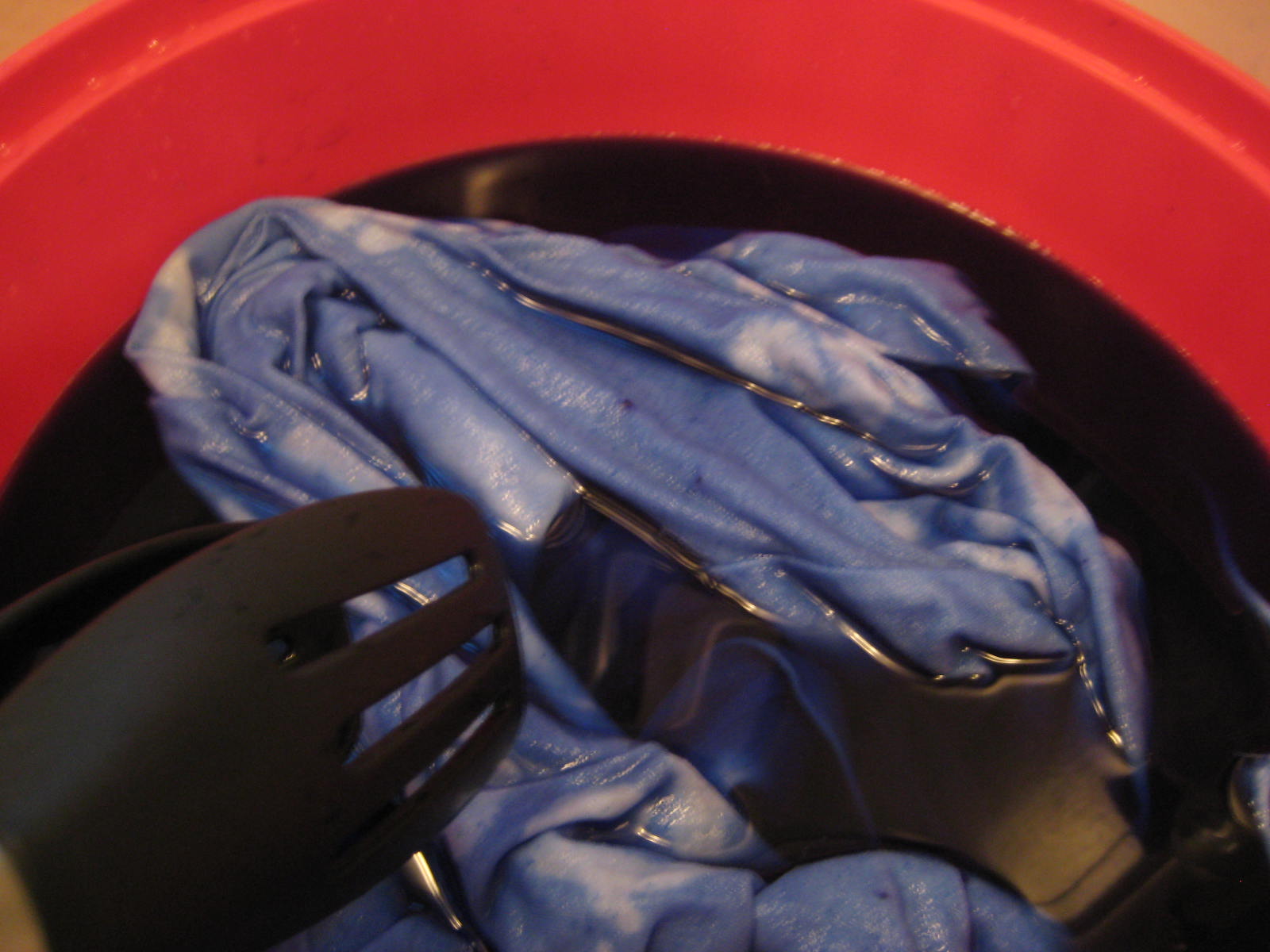
Carefully submerge the shirt in the dye bath and let soak for 10-30 minutes, depending on the depth of color you want, how much patience you have, and how much you trust your glue to hold. 😉 Stir gently, but occasionally. While you’re letting it soak, use bleach spray to spray down every counter and floor surface that you looked at or breathed on while making the dye bath, otherwise you’ll be surprised for the next week about all the flecks of dye that turn up in unusual places.

Carefully remove t-shirt from the dye bath, and hang to dry in a place where it’s safe to let it drip dry. (Like outside above a patio that you don’t mind if it’s stained blue.) Let dry overnight until completely dry. The glue will appear speckled with dye, which will wash out. One does not need to start over because of the speckles.

Gently rinse the shirt in a cool soapy bath to remove the glue. Rinse several times, until water runs clear.

Wash as usual, and dry.

I love the subtlety of the design, and the power of the message. And I love the fact that it doesn’t have to be perfect to be pretty, otherwise I would be a complete craft failure! If one was artistic (Ken) pictures could be drawn, or patterns made. The possibilities are endless . . . as is the time it takes to complete the project! 🙂

What do you think?

An “Ouch” Well Worth It

Today, Ken and I went for our second round of vaccines. We each received three vaccines, one of which was the dreaded yellow fever vaccine. You know it’s going to hurt when the nurse specifically told each of us before she even started to give it to us that we must not pull away while receiving the vaccine. Funny, she had never mentioned that with the others. But there was good reason for the instructions for the yellow fever vaccine, although the others weren’t spectacular either.

And, as usual, I feel crummy after the vaccinations. The wheezing started while I was still in the office, and now my throat is raw, my head feels like it’s going to explode, and I feel generally yucky. I’m know I’m mildly allergic to some preservatives in injections, but we’ve never isolated which ones because I’ve never had a full-blown anaphylactic reaction. An allergic reaction is definitely better than yellow fever. Or polio. Or meningitis. Or hepatitis. Or typhoid. So it’s worth the risk, as long as my epi-pen is handy.

But now the worst of the shots is over, and I just have to go back for one booster in February, to confer lifetime immunity. There’s a good chance we’ll even travel before then. We actually have been so thoroughly vaccinated now, we are good to travel just about anywhere, except rural areas of Asia during Japanese encephalitis transmission season.

But our hearts are set on Kinshasa, and every needle stick, aching arm, low-grade fever is worth it to bring our kids home!

This slideshow requires JavaScript.


The Best Immigration Appointment EVER

Ken and I had our appointment for fingerprinting today at the local support office for Immigration.

We’ve been to many Immigration offices and appointments. When Ken came to the United States, he took the “scenic route” to getting his green card — working under a religious worker visa first. There was a difficult and incredibly long transition to get his green card. Five years of paperwork, Immigration errors, appointments, letters, hundreds of dollars, waiting, waiting, and more waiting finally resulted in his green card. And each time we went to one of those Immigration offices, there was a palpable sense that life as we knew it was threatened.

Today was different. Today was about adding to our family without fear of, well, subtracting from our family. The officers were pleasant, efficient, and engaged in amusing chit-chat.

In fact, we had a good time! Now that’s a first!

The Great Name Debate

What in the world should we name our children? Or should we name them at all? That is the great name debate in our household.

When we received our referral information in August, we received not only pictures, but names and medical information on the children. They had both African names, and English names: Rose and Emmanuel. Of course, we’re a bit confused. Are they called by their African names (which we don’t know how to pronounce) or by their English names? Have they just begun to be called by their English names, or are the names a sort of pseudonym for us to use when we communicate about them with our agency?

So, we’ve faced a quandary. What should we call them? What will we call them?

We could keep “Rose” and “Emmanuel” as their names. They are perfectly fine names, and they may be already answering to those names even as we speak. They are easy to spell and pronounce, and will fit in with American culture.

We could keep their African names. Although we don’t know how to pronounce them — or even what language they are in, it’s something we could quickly catch on to. If I have indeed figured out how to pronounce Rose’s African name, I actually think it’s kind of cute. And with all of the change that the children are about to go through, keeping their name the same might be one less change. But still, their names will always be difficult to pronounce to Americans, and they won’t know anyone else with similar names.

We could reuse the names that we had intended to use for the twins, who indeed never existed, so the names have never been used. In fact, we were seriously considering this option before we lost the three- and six-year-olds who were originally referred to us. But in all honesty, to attempt to name a third pair of siblings “Palmer” and “Emelia” has lost its appeal, at least for now.

We could rename them entirely. After all, they will be our children, and we have that right. To be honest, I would really love to name our children ourselves. I’ve always loved choosing names, but other than naming our dogs, Buddy and Holly, I’ve not had the chance to choose many names. Oh sure, I’ve made suggestions for names, like when I suggested that my chemistry-teacher friend name her daughter Ethyl Methyl Polly Ester. Somehow, she didn’t go for it. 😉

Why all the name debate? If the children were younger, it wouldn’t be such a quandary. But three and four year olds are old enough to know their names. Orphans have so little to call their own. Quite possibly, the only thing they will come to us with is the clothes on their backs, and their names. To thoughtlessly take away what little they have doesn’t seem right.

So we have decided  . . . not to decide, at least for now. We probably won’t decide until we get to the Democratic Republic of Congo and find out a little bit more about their names and their significance. We’ll probably tuck a naming book into our luggage as we travel. For now, we’ll probably still refer to them as “Rose” and “Emmanuel,” since that seems a bit more personal than “the boy” and “the girl,” even though I really don’t necessarily want those names to “stick.”

So at least the foreseeable future, the great name debate will continue. What in the world should we name our children? Or should we name them at all? Only time will tell.

Our Miracle Has Arrived!

Six weeks ago, we needed a miracle. We needed $13,000 within 90 days for our referral for a sibling pair from the Democratic Republic of Congo, and we didn’t have it. We also needed approximately an additional $4000 for other fees as well. We needed money to rain from heaven, and in fact, it did.

We began to hear from many who told me that God had told them to donate a specific amount to our adoption, and they were doing so out of obedience, out of love for us, and for the plight of these precious children.

As we’ve crunched the numbers, gathered checks, calculated amounts we have received, and funds that our agency received directly, I am excited to announce that our miracle has arrived.

We are paying off our $13,000 referral fee and our $1000 post-placement deposit fee  TOMORROW.  God didn’t even need 90 days. In half that time, through the generosity of His saints, we are paying the fees to be able to rescue this 3-year-old girl and 4-year-old boy. We stepped out in faith, not knowing how the miracle would happen, but many of you stepped out in faith right along side us.

Thank you for travelling this journey with us. Thank you for your generosity. Thank you for your prayers and kind words.

And thank you sweet Lord for our miracle!

We hope to be able to pay off the final $2300 agency fee within the next couple of weeks, and the remainder of our vaccinations when we get them next week. We will then be transitioning to raising funds for travel expenses. We’re estimating at least $6000 for flights alone for all four of us, but it is difficult to predict airline fares, especially if we need to travel with little notice. We are planning on saving money by staying at a convent in Kinshasa, rather than a hotel, which will also provide us with economical meals as well. We’ve already paid over $21,000 of the expected $28,000 total, and it looks like total expenses will be closer to $30,000.

We know that we still have a way to go to raise the funds that we need by the time we travel, but it seems small in comparison to $13,000 in 90 days! The bulk of the “ransom” has been paid!