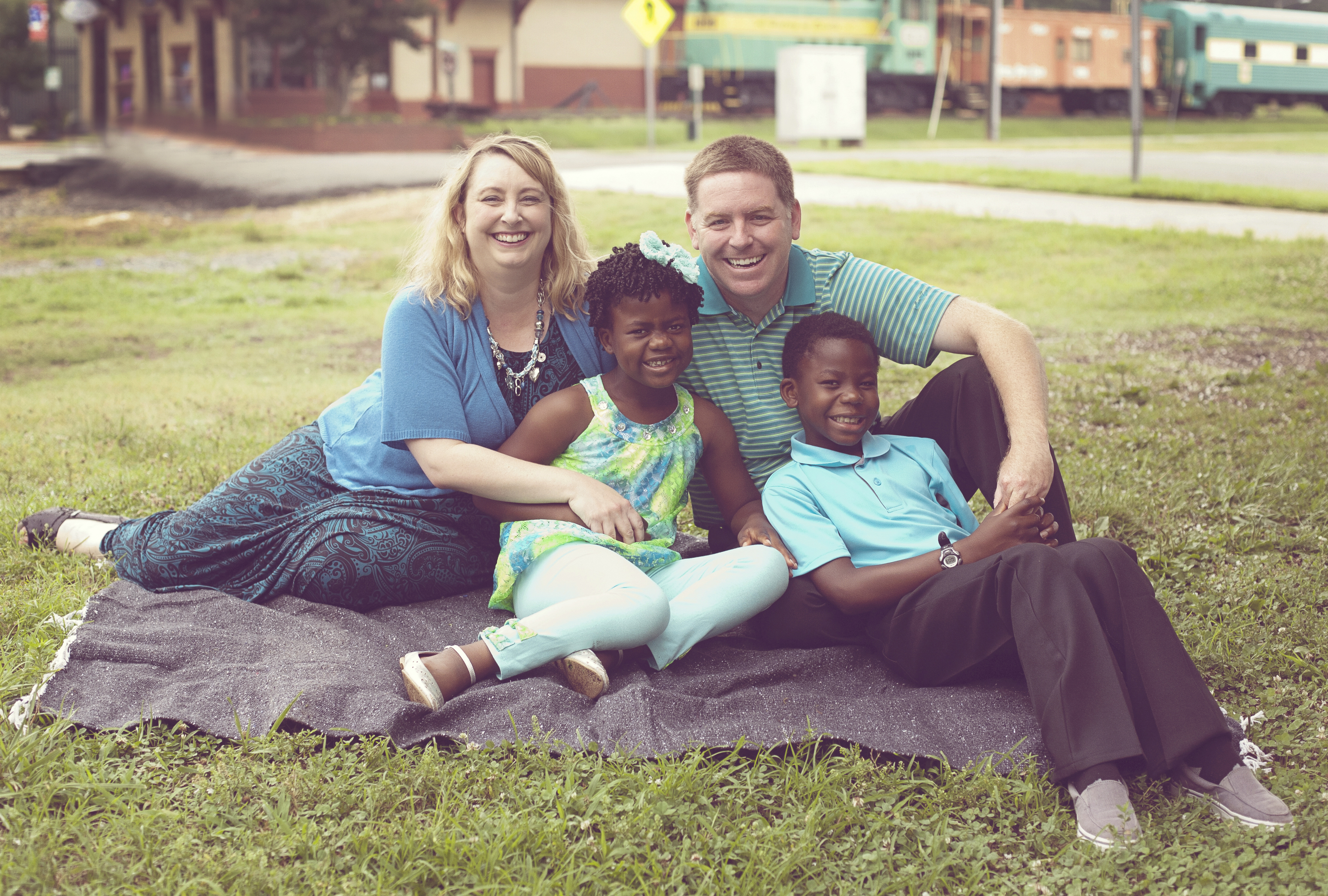
Making Sure More Have a Merry Christmas!

It is amazing to see how God has worked in the lives of our children over the past two years, and it is our sincere hope that we would continue to have an impact on the orphan community while we are in Ghana. I hope to volunteer at a clinic that is on an orphanage property, treating not only the orphans there, but the Muslim women in the community as well.

Not everyone is called to pick up and move halfway around the world to help orphans, or even to foster or adopt an orphan. But we are all responsible for caring for the fatherless, the poor, and the foreigner. Scripture encourages us over 30 times to care for the fatherless, to include them in our prosperity, to defend them when they cannot defend themselves. Cultures of poverty can lead to families having to give up their children to orphanages or selling them into slavery. Most of the world’s orphans have extended family, but they are too poor to care for the children. The good news is that by adjusting our spending habits, we can significantly reduce the number of orphans and slaves in the world. In this season of abundance and generosity, please consider to remember where your gifts have come from, and the hands that were made to produce them.

chocolate_slavery_mainFor instance, there are 242,000 young people in slavery in Ghana, many of them children, and many working in the chocolate industry. Most of us buy chocolate near the cash register that supports that slave industry. If we were to look a little harder in the candy section, most grocery stores carry Fair Trade chocolate, such as Divine Chocolate, which is produced by the farmers in Ghana who are paid a not only a fair price for their crops, but an additional financial investment to help bring their communities out of poverty.

Coffee is another commonly purchased item that we almost all have in our homes. In fact, coffee is the second most traded commodity in the world, next to oil. Coffee growers typically receive as compensation only 10% of what we pay for coffee when we buy from the big brands. Growers are often forced to sell their coffee for less than what it cost to produce it, essentially enslaving them as they have to work their way to pay off what it cost them three years to grow.  If we all pictured those trapped in poverty by our brand loyalty when we hit the switch on the coffee machine in the morning, it wouldn’t really be “the best part of waking up,” would it?  If instead we all decided to purchase Fair Trade coffee rather than the most popular brands we see advertised, we could shape the way coffee growers in third world are treated and compensated, bringing hundreds of thousands of people out of poverty.

Those are just two examples of how our dollars can be used to treat those in developing countries with fairness and justice. There are many more ways you can consider making your dollar go a lot further when shopping this Christmas season. Here are just a few of the hundreds of opportunities you can take part in to help defend the cause of the poor, the orphan, and the foreigner.

Shop to Support Adoptive Families

Child Sponsorship and Gifts

 Fair Trade

  • The Hunger Site — A huge site that offers the opportunity to shop to benefit causes that are important to you — Fair Trade, Autism Awareness, Breast Cancer Research, and more. Hundreds of items at great prices from toys, to apparel, to footwear and more. You’ll find lots of great items at this store!
  • PACT — A Fair Trade clothing retailer of fun and funky basics — socks, underwear, t-shirts, and hoodies.
  • Global Mamas — Sells unique handcrafted items in colorful fabrics made by Ghanaian women to improve their standard of living.
  • PartnersForJustTrade.org — Faith-based Fair Trade organization bringing craftsman out of poverty by connecting them with consumers in North America.
  • TenThousandVillages.com — Fair Trade retailer since 1946 providing a wide variety of merchadise for all ages from around the world.
  • NoondayCollection.com — Supports artisans around the world and provides opportunities for adoptive families to raise funds to bring their families together.
  • TradeAsOne.com — A store and subscription-based Fair Trade service that ships grocery items every 3 months for around $1 a day. Introduces consumers to the variety and quality of Fair Trade items.
  • Amazon.com — This popular retailer is continually expanding its selection of Fair Trade products, but you MUST search for them by typing in “Fair Trade.”
  • Fair Indigo — A retailer that allows you to shop your conscience, carrying Fair Trade, USA-made, upcycled, vegan, and organic items. This retailer has been a consistent favorite of ours!

Other ways to reduce the number of slaves and orphans in the world

  • Buy clothing and household items at second-hand stores that support charity rather than slavery.
  • Buy coffee from Fair Trade sources, then add more Fair Trade products over time.
  • Review BetterWorldShopper.org  or Free2Work.org to rate practices of the retailers you frequent.
  • Investigate your slavery footprint at SlaveryFootprint.org.

Even if you may not be able to make a difference with all of your purchases this Christmas season, each and every purchase helps! Your dollars let retailers know that you care when they donate products to good causes, use ethical sourcing, and pay their workers fair wages. Every time you make a purchase, you are essentially voting on how you believe we should treat employees around the world.

“This is what the Lord says: Do what is just and right. Rescue from the hand of the oppressor the one who has been robbed. Do no wrong or violence to the foreigner, the fatherless or the widow, and do not shed innocent blood in this place.” Jeremiah 22:3 NIV

Thankful for Two Years

Two years ago, Addie had been just diagnosed as being developmentally delayed. In spite of the fact that we now knew that she was six, the experts determined that she functioned at the level of a three year old. She could barely climb stairs while alternating feet. She didn’t walk as much as she toddled. Her femurs were bowed from rickets. Heavy metal deposits laced her bones. Her bone marrow was hyperplastic (enlarged). She only spoke a few individual words of English. “Balloon.” “Dog.” “Airoplane.” We had no idea what she was thinking or feeling, except for her grief expressed through peeing on furniture, hitting other children, and stealing toys from school.

Today, Addie has met her goals for her IEP in language, reading, fine motor skills and gross motor skills. She plays hockey on roller blades in the driveway. She loves to read, and to talk. She is loved by her classmates. She tells stories, expresses her feelings, loves Jesus, and has the gift of intercession. When faced with high expectations, she rises to them, even if she wants you to believe she’s not capable. Her speech therapy this year has helped her make amazing strides in her articulation. God is doing amazing things in Addie’s life.

Two years ago, Palmer screamed for hours after every trip to church, but we were never sure why because he didn’t have the words to express what was wrong. He was being moved from Kindergarten to first grade after only 6 weeks, because we had just found out he was 8 instead of 5. His teacher reported that he said three words, “Yes, no, and pizza.” The expression on his face varied from flat to livid. He was defiant to women in authority. He was an angry grieving boy, who would not allow anyone to comfort him in his sorrow.

Today, Palmer loves going to church. He can repeat verbatim the lessons told in Sunday School, children’s church, and even adult service. He loves God, who has transformed Palmer into a joyful leader with a discerning eye for how things work and how to make them better. He loves to ask difficult questions, like “Why are there so many doctors in America and not enough in Africa?” and his greatest dream is not a trip to Disney or an XBox 360, but for there to be enough doctors in Africa to take care of the sick people there. God is doing amazing things in Palmer’s life.

Two years ago, Ken was working six evenings a week and all day Saturday and Sunday, between Upward Sports, college ministry, and regular church activities. It was exhausting him and breaking our fragile family. Time when all four of us were together was rare.

Today, Ken is able to be a stay-at-home dad, newly appointed missionary, and volunteer minister. He is allowed to preach (his primary spiritual gift) at least once a month, and is able to dedicate his full-time efforts to getting us to the mission field. Ken is renewing his knowledge of French and preparing to minister to pastors across West Africa in English and French. We eat dinner together at our dining room table every night. God is doing amazing things in Ken’s life.

Two years ago, I was battling a third week in a row of pneumonia, which triggered my asthma. I was on mega doses of steroids and antibiotics just to keep me breathing, and starting a new $3500/month shot to try to keep me from being disabled from my asthma. I was too busy to be hospitalized, as our new little family could not take any more absences with Ken already being gone every night. Yet between working, taking care of Addie’s medical needs, re-aging the kids, getting them moved into new grades, and functioning as a single parent in the evenings, I was too busy to get well. I was suffocating physically and emotionally.

Today, I have been off of all asthma medicines for four months, even when we went to Africa, where the air is smoke-filled from hundreds of thousands of people burning their trash. I feel better than I have felt in a decade. I am preparing to start a new clinical job where I will be seeing geriatric patients in their home, carrying my doctor’s bag with all my clinical supplies with me as I travel. This opportunity will refresh my clinical skills in preparation for the mission field, and allow me to practice medicine how I feel it should be practiced: patient-centered and holistic, without the pressure of seeing a new patient every 12 minutes. God is doing amazing things in my life.

Today, I am thankful for two years.

Jewett (5)

Overwhelmed

Ken and I sat alone in a coffee shop in downtown Charlotte two weeks ago, reflecting on our trip, sipping on lattes and eating quiche. Tamale would be so much different. Life would be hard. We had hoped for an overwhelming sensation of loyalty and love while we were there. We were overwhelmed. Just overwhelmed.

The extra time allowed by the cancellation of our trip to Burkina Faso had proven to be very beneficial. Within 24 hours of getting sick, my travel sins were forgiven, and I was on the mend, ready to travel again. The remainder of our time in Tamale had been spent in numerous conversations about logistics, where our kids would go to school, how I would earn the right to practice medicine in Ghana as a physician assistant, where we would live in a rapidly changing housing market, how we would focus on sustainability and dignity among the Ghanaians. We visited stores, schools, clinics to try and gain an image of what life would look like if we lived in Tamale.

We had a huge decision to make. Pros versus cons. Mourning what we would give up. Relishing what we would gain. Trying to see down the wide road, and the narrow road. For over an hour, we went back and forth. Which life should we live? It’s always been easy for me to have faith for someone else — to say, “of course you should become a missionary.” It’s much harder when the decision is mine.

Tamale was overwhelming. Uprooting the kids. Selling our house. Saying good-bye to cousins, aunts, uncles, and parents. Rehoming our dogs. Getting rid of the vast majority of our possessions. Saying goodbye to the comforts of America. Living a life completely dependent on God and His people. Moving halfway around the world.

In the end, we had to ask ourselves: What is most important to us? Which existence is worth the investment of our lives?

The American dream. A 3 bedroom house with a Jeep and a minivan. Two kids. Two dogs. An acre of manicured lawn. Plenty of clothes, toys, and expendable income. Comfortable jobs where sharing our faith would be easy, but lives changed would be infrequent. We have tasted the American dream and find it, well, lacking.

The life of missionaries. A cinderblock house at the edge of the desert. Two kids. A city mired in poverty and darkness that needs the light of God’s love. The need for investment is tremendous but rewarding. Sharing our faith would be difficult, but souls are frequently being transformed, and churches are growing in number and need the kind of mentoring we could provide. We have tasted what God is doing in Africa, and find it rewarding.

Ultimately, our lives are not our own. Ken and I want to live a life which is most glorifying to God, in a location where God is working in miraculous ways, and which best fulfills the Great Commission. At the end of our lives, we want to have no regrets about whether or not we could have done more to invest in God’s kingdom. There is no better life investment than one that gives our best to see others know God and glorify Him. We are overwhelmed that God would even ask us to be a part of such great Kingdom work.

Luke 18:22-29, NIV

When Jesus heard this, he said to him, “You still lack one thing. Sell everything you have and give to the poor, and you will have treasure in heaven. Then come, follow me.”

When he heard this, he became very sad, because he was very wealthy. Jesus looked at him and said, “How hard it is for the rich to enter the kingdom of God! Indeed, it is easier for a camel to go through the eye of a needle than for someone who is rich to enter the kingdom of God.”

Those who heard this asked, “Who then can be saved?”

Jesus replied, “What is impossible with man is possible with God.”

Peter said to him, “We have left all we had to follow you!”

“Truly I tell you,” Jesus said to them, “no one who has left home or wife or brothers or sisters or parents or children for the sake of the kingdom of God will fail to receive many times as much in this age, and in the age to come eternal life.””


We are moving to Tamale, Ghana.

Jewett (33)

Collapsing

I awoke with a start. I wasn’t sure if I had a bad dream or a bad dinner, but I was drenched in sweat.

“Don’t go, don’t go.” pulsed through my head as if a dream lingered that I could no longer remember.

I sat up, and drops of sweat splashed off my nose and chin onto the sheets. I felt dizzy, nauseated, achy, confused.

“Don’t go. Don’t go.” Wait, don’t go where? Where am I?

I oriented myself from the light from the balcony outside of our room as it peeked through the curtains of our air-conditioned hotel room. I remembered I was in Tamale, Ghana. The next morning, we were leaving for Ouagadougou, Burkina Faso.

“Don’t go, don’t go, don’t go, don’t go” drummed with every heartbeat.

“Well, that’s silly,” I thought. “That’s the biggest reason why we came!”


Burkina Faso is a brand new mission field for Global Partners, the missions department for The Wesleyan Church. A small, landlocked, and primarily Muslim nation located just north of Ghana, Burkina Faso had only months prior received three of the most recent Wesleyan missionaries from Haiti, and we were going to visit them. We have been praying for these three men for months, and have their pictures on our refrigerator at home. This is the first time The Wesleyans have sent missionaries from one developing nation to another on a completely different continent, and in a completely different culture. The only commonality was the French language. For this reason, Ken had spent months with Rosetta Stone, brushing up his French.

As I processed these thoughts, the first knife-like abdominal pain came. The list of my travel-related sins passed through my mind:

  • My shoe had fallen off and I had stepped in the mud on Sunday.
  • I had eaten raw or undercooked produce . . . at most meals.
  • I had been bitten by all manner of mosquitoes and black flies at least a dozen times.
  • I had accidentally rinsed my toothbrush with tap water instead of bottled water.
  • I ate a meat of unknown origin and questionable identity for dinner the previous night.
  • There was a known cholera outbreak in the city where we had stayed in southern Ghana.

As I bowed before the porcelain throne of repentance, the list of differential diagnoses was narrowed to one: E. coli.

No one likes an E. coli infection. Especially in a foreign country. Especially when you are planning on traveling back to the United States and they won’t let you on an airplane unless you’re the picture of health. Especially when any febrile complaint will be perceived as Ebola, even when you have remained hundreds of miles of African dirt roads and several borders from the nearest case, and it is only contagious by contact with infectious body fluids from a symptomatic person. I knew I didn’t have Ebola, but I knew the paranoid American public would never believe me. I was not afraid of Ebola, but I was afraid of American’s fear of Ebola and what they would do to me if I got sick while in Africa.

I scrambled through the portable pharmacy I had brought with me for Cipro, and downed my first dose of absolution before waking Ken.

I sat next to Ken, ashen and still sweating giant beads of sweat like raindrops.

“I can’t go to Burkina Faso,” I muttered. “I have to stay here.” It was all I could get out before I was exhausted and doubled over in pain. I didn’t have the energy to explain the weird dreamlike sensation to not go to Burkina Faso. It was probably just my fever anyway.

When morning came, Ken packed a small bag, and arranged for me to stay in the hotel room another night. He brought me extra water for the day and a half I would be spending alone, and made me promise to contact the front desk for medical help if I needed it. The Cipro had already begun its work, but I was still miserable.

Ken kissed me goodbye, walked out into the blazing heat, and I drifted back into a dehydrated sleep.

To my surprise, two hours later, Ken walked back in the door.

“There may be a small matter of a riot, so we are reevaluating if we should go. We will make the decision within the hour.” Ken explained.

What the rest of my body didn’t have energy to do, my sweaty fingers did. I began to frantically search.

No United States State Department Travel Warning.

No US Embassy alert.

Then I checked news agencies, and I was shocked with what I read. News was breaking every time I hit the refresh button.

Thousands of protesters were marching on Parliament.

Thousands of protesters in Ouagadougou.

Refresh.

Protesters had broken through police lines at Parliament. Police retreat.

Protesters pose with a police shield outside the parliament in Ouagadougou on October 30, 2014 as cars and documents burn outside. (AFP Photo/Issouf Sango)

Rioters confiscate gear as police flee.

Refresh.

Parliament is on fire and being looted by rioters.

Prostestors enter the parliament in Ouagadougou on October 30, 2014. (AFP Photo/Issouf Sango)

Protesters loot and burn the Parliament building in Ouagadougou.

Refresh.

The state television station has been taken over by rioters.

Image: Anti-government protesters take over the state TV podium in Ouagadougou

Refresh.

The Burkina Faso Army moves in and declares martial law, disbanding Parliament.

Burkina Faso - Demonstrationen gegen den Präsidenten.


Refresh.

The airport in Ouagadougou is shut down. No flights incoming our outgoing.

Refresh.

President Campaore resigns after 27 years of power. He is looking to escape the country.

Within an hour, the situation grew dire.

The pounding of my heartbeat, “Don’t go, don’t go, don’t go,” began again, but not for myself. Ken had to make the decision about whether he would still travel into Burkina Faso in what looked like was going to be a complete takeover of the government by either civilians, or the Army.

Ken returned to the lobby to hear what the National Superintendent, with whom he would be traveling, had to say. And then he returned to the room.

“It looks like we’re going to have some down time in Tamale.”

I smiled, took another dose of Cipro, and collapsed in relief.

Later, we realized that the Burkina Faso borders closed that afternoon, and remained closed for days. Indeed, the government has changed hands, a temporary government has been established. The United States Embassy locked down, and staff were ordered to shelter in place. Without me, Ken could not have entered the US Embassy for protection. Had Ken traveled, he would have been trapped in Burkina Faso. I would have had to either return to America without him, or wait until the border reopened.

It’s not every day that the country you are planning to visit collapses.

The situation in Burkina Faso is currently in transition. The former president is still on the move, going from Ivory Coast to Morocco, seeking protection. Civilians are now wrestling with the military, who assumed power. But the people of Burkina Faso didn’t overthrow the government to put a military leader in power. The hope is that within a year, free elections will be held.

It doesn’t take much imagination to realize what an important time this is for Burkina Faso. As a Muslim nation, they have been a key ally for US interests in the area as they fend off Al Queda and other radical Islamic groups in the region. The next year could determine whether Christian missionaries are allowed to stay and be safe in the region, or whether they will be ousted. The next year could determine whether Burkina Faso will continue to be one of the fastest-growing areas for Christianity in the world, or whether the sharing of the gospel will be restricted.

The next year is a great time for the saints to be lifting up the nation of Burkina Faso and the missionaries there, who may have a tenuous window of time to share the steadfast message of the gospel.

II Thessalonians 2:1-3,  NIV “As for other matters, brothers and sisters, pray for us that the message of the Lord may spread rapidly and be honored, just as it was with you. And pray that we may be delivered from wicked and evil people, for not everyone has faith. But the Lord is faithful, and he will strengthen you and protect you from the evil one.”

Seeing Through New Eyes

The tall green grasses of the African plains waved greetings to us as we rode into the city of Tamale in the church van. The African sun brought unrelenting dry heat to the land. Mud huts sat huddled along the roadside in small villages. Motorcycles and scooters buzzed around our van on roads that were, dare I say, smooth, for the first time since we arrived in Ghana.

As we entered the city, the contrast of centuries surrounded us. For the most part, the clock had been turned back 100 years or more. There were no supermarkets, fast food restaurants, or anything much in the way of modern conveniences. The evidence of poverty was reflected in the numerous children who worked along the roadside during school hours. The gaunt faces of hunger were dispersed through the crowds. The homes of pieced-together scraps of wood, metal, mud, and grass were scattered among the brick walled-in palaces. Mud huts sat next to modern gas stations with mini-marts. Internet cafes were hosted in ramshackle ruins. The church on every corner was replaced by a mosque in every neighborhood, and the haunting calls to prayer echoed through the air. Almost all women had their heads covered, most in a hijab.

This was definitely not the same as Accra.

My brain fought to push back the images of radical Islam in my mind, and I prayed that God would replace the thoughts put in my mind by Western media with His perspective.

I began to envision Jesus standing over the city of Tamale, just as He had stood over Jerusalem the week of His crucifixion.  Luke 19: 41-42 says,

“As he approached Jerusalem and saw the city, he wept over it and said, “If you, even you, had only known on this day what would bring you peace—but now it is hidden from your eyes.””

I began to envision the spiritual darkness that these people live in, especially the women of Tamale. They are limited in their contact with people outside their families. Their husbands often control how much health care they get, what spiritual influences that they have, and the punishment for disobedience can be severe. With one physician for every 93,000 patients in this region of Ghana, health care is already scarce. But considering that Muslim women cannot be cared for by a male physician creates a nearly impenetrable gender barrier.

The story of one woman in particular hit home with me. Her name is Lapah, and she had been sick for many years. She had sacrificed animals. Still sick. She had prayed to idols for healing, with no results. When the Jesus Film came to her village through the ministry of Global Partners, she prayed to receive Christ, and prayed for healing. And the power of Jesus Christ healed her. Not only was she saved, but her daughters were saved as well when she shared what the One True God had done for her.

In southern Ghana, Jesus is on every sign. Modern conveniences are everywhere. Life would look a whole lot like what it does here in America. Accra would be comfortable.

In northern Ghana, Islam is on most signs. Modern conveniences are hard to find. Life would be much harder — finding food, water, and relief from the desert sun would be a daily struggle. Tamale would be intimidating at best. Frightening at worst.

But which city does Jesus weep over?

For years I have said, “I would rather do something perilous for the sake of love, than nothing for the sake of fear.”

“There is no fear in love. But perfect love drives out fear, because fear has to do with punishment. The one who fears is not made perfect in love.” I John 4:18, NIV

Ah Yes, This is How Things Work in Africa

The plane touched down on the runway in Accra, Ghana, and the passengers immediately burst into applause. We were thankful to have made the long journey from Amsterdam — and many much further. After having two hours of mechanical difficulty before even lifting off the ground, we were all relieved to have made the journey safely. We were surprised by the cool rain that was pouring down on the hot tarmac, but relieved to get a temperate welcome rather than a scorching one.

Our trip to Ghana had already provided the opportunity to make many new friends. At the boarding gate in the Amsterdam airport, a crowd of Ghanaians pressed in around us to hear our plans to visit Ghana as a part of a vision trip to investigate if we could see God using us there, and in what ways. “I would like to give you my phone number, so you can call me if you need help,” was the response from multiple people in the hours along our journey.  We received recommendations on where to live, who to trust, and how to avoid being taken advantage of as foreigners. “Remember that there is one price for Ghanaians, and a higher price for foreigners.”

Ah yes, that is how things work in Africa.

We had traveled to the Democratic Republic of Congo just two years prior, and the memories of corruption were still fresh. We had been held by the police more than once, forced to pay to be able leave the country, denied boarding passes to get on the plane, had Addie’s passport stolen by airport officials, and were abandoned by our paid translator. Anyone with even a little authority in Congo, especially the police, used it for corrupt purposes. They knew that we white mzungus were traveling with plenty of cash for unexpected emergencies, and they were all too happy to provide such emergencies to relieve us of our money. I knew if my perception of Africa did not change, I would never be able to live there, in a constant state of paranoia. I needed Africa to be redefined in my mind, and in my heart.

After 4 hours to get through Ebola screening, immigration, baggage claim and customs, we finally walked out of the airport at around midnight — more than 30 hours since our trip had begun. Fortunately, Rev. Joe Ocran and his wife Jemima were waiting for us, welcomed us warmly, and drove us to our hotel for a brief night of rest.

As we rode through the dimly lit streets of Accra to our hotel in Tema, I couldn’t help but be reminded of our last trip. The smell of dust, burning trash, and car exhaust mingled in my nostrils as a familiar reminder of the smell of Africa. I was amazed that even though we were hundreds of miles away from the Congo, the aroma was still the same, as were the roads. Even though it was late at night cars and motorcycles weaved dangerously in and out of lanes of traffic. Potholes were the rule, rather than the exception. The midnight streets were still abuzz with activity.

The one difference was the jovial Joe Ocran, the National Superintendent for The Wesleyan Church of Ghana. A dual citizen of both Canada and Ghana, Joe was a delightful host who chuckled affably at the culture clashes we were already experiencing. We laughed most of the way to the hotel in Tema, where we would stay for the next two days.

As we drew closer to the hotel, the streets became darker, the roads became more uneven, forcing us to slow, and the police were visibly more present. I could see their eyes searching our vehicle. I suddenly felt very white, even in the darkness.

At last, we caught the attention of a pair of police officers at a roundabout, and they motioned us to the side of the road to inspect our vehicle. They approached with flashlights fixed on the interior of our vehicle. The dark veil of night could not hide our foreign identities.

“Ah yes,” I thought to myself, “This is how things work in Africa.”

Palmer’s Dream

I knew that it would take Palmer a long time to process what it means to move back to Africa, but I also knew that it was on his mind often, because every few days he would ask questions like, “Can I have a bicycle in Africa?” or “Can Grandma and Grandpa come and visit us in Africa?” and “Can Buddy and Holly come?”

Palmer has had a lot to process internally regarding Africa. Being the older of the two siblings, he has more memories, more sense of responsibility, more regret about all that happened. He remembers losing family members. He remembers struggling for survival himself. He remembers being displaced in the orphanage. He remembers saying good-bye. Palmer has a nearly photographic memory for many things. It serves as both a blessing and a curse.

For Palmer, it’s almost like these hardships have made him work all the harder now to appreciate the opportunities that he has. He works hard in school, at soccer, at chores. He appreciates what he has, and takes good care of everything he owns. He is rarely disobedient.

He is our responsible child.

I knew that this sense of responsibility has weighed heavily on his heart, when he asks how his family is in Africa. Is the orphanage still there? Are any of his friends still there? There is a tender balance in his heart of living life to its fullest in America, but remembering those who were left behind.

Palmer hides these things in his heart well. Most of the time, he is an incredibly goofy happy kid who loves to laugh. But if you look in his eyes at a serious moment, you can catch a glimpse of the years of experience he is too young to have. At times, he seems like an old man in a boy’s body.

I take what Palmer thinks and feels very seriously. He is still a child, but he has considerable survival skills and analytical skills. He is very wise for a not-quite-10ish year old. He challenges me to think about life differently as our cultures collide and mingle under one roof.

We patiently waited for weeks for Palmer to give us his answer about moving to Africa. His reaction had been fairly silent at first, but I knew that the Holy Spirit would speak to Palmer in His own way, in His own time if this was indeed what God had for our family.

Several weeks ago, we were having Sunday lunch from our favorite Chinese takeout buffet. We were taking turns reading fortune cookies. When Palmer opened his, it read, “Your dreams will come true when you least expect it.”

Jewett (13)“Palmer, what’s your dream?” Ken asked.

“I don’t have a dream,” Palmer replied.

“Martin Luther King Jr. would be so disappointed.” I replied with a wink.

“Not a dream at night, Palmer, a dream can also be a big wish.”

I added, “So would you like to go to Disney World like your friends? Or go to the beach like we do at Christmas? Or a new video game system? What’s your dream?”

Palmer thought for a few moments and then replied, “My dream is that there would be enough doctors to take care of all the sick people in Africa.”

We had his answer. An unselfish boy realized that giving up what he has in the United States is worth it to move where healthcare is needed most. I do not take lightly the choice that he has made.

The Holy Spirit, in His own way has spoken to each of our hearts separately, and together. None of us decided on our own that moving to Africa was the right thing to do, but by prayer and consideration, God has made it clear that He is leading us back to the continent from which our children came. God does not have a calling that is separate for Ken and I than from our children. They are called by God too, and I am convinced that God will use them as much, if not more, than Ken and I while we are in Africa.

And the same God who called us as individuals and as a family has a plan for each of us, and all of us, in Africa.

Now to start the process of getting there . . .

Permission to Go or to Stay?

Our minds weren’t set, but they were open. In many different areas of our lives, we felt an increasing tug of our hearts toward Africa.

Henry Blackaby wrote in Experiencing God Day-By-Day, “Our Master commands us to ‘go.’ We need permission to stay!” Was God asking us to go long-term? Short-term? We needed help answering that question.

Ken and I both wanted to explore opportunities to serve The Wesleyan Church in Africa through their international ministry, Global Partners.

Early on August 6th, two months after our original conversation,  we participated in a Skype call with Bob Bagley, the Global Partners Area Director for Africa, to learn more about the areas of need in Africa, and how we might be able to fill those needs.

Immediately, I was impressed with how clearly and compassionately Bob understood our unique family dynamics, and the gifts that we bring. In order for Africa to be a good fit for our family, we would need:

  1. A place where Ken would have easy access to internet and transportation, so that he could help with the French-speaking churches of Africa, and with business management.
  2. A place where the kids could attend international school. Boarding school wouldn’t be a good option for our family, and homeschooling might limit our ability to build relationships, especially for our kids, who have already had to make new friends many times over in their short lives.
  3. A place where I would be able to find needs and be able to fill those in the medical field. Physician assistants are not able to practice medicine in all countries, so I cannot just move anywhere and use my skills in medicine.

In advance of our conversation that day, Bob had already thought through all of these complex issues for our family, and suggested the country of Ghana.

Ghana is an English-speaking country that has many international schools that could be excellent options for our kids. Though Ghana is a Christian country, the northern part of Ghana and its northern neighbor Burkina Faso are predominantly Muslim — and this is where the church is rapidly growing! There are many churches being planted in northern Ghana and in Burkina Faso whose pastors need mentoring, training, and encouragement.


Overall, Ghana also has a tremendous need for medical providers, with a ratio of one medical provider for every 10,000 people. In southern Ghana, there is even a clinic run by The Wesleyan Church. In northern Ghana there are fewer medical resources and the ratio is one physician for every 93,000 —  the needs are critical.

At the close of our conversation, Bob recommended two things: that we consider taking a vision trip to Ghana and Burkina Faso to see for ourselves what God is doing in Africa, and to begin to fill out our applications to become long-term missionaries.

As for the trip that we spoke of with Bob in August, we are leaving for that very vision trip this Friday, October 24th. Ken will be preaching and meeting with several of the new pastors in the area to encourage them, and I will be seeking opportunities for creating sustainable health practices in Ghana using networks of the local church to address medical needs. We are excited to see what God is doing in West Africa, and to explore how God might use our family in this part of His kingdom!

Things are just about to get very interesting.

Along the Way

After nearly two months of praying, considering, seeking advice, Ken and I decided to start talking about Africa. Had he been hearing from God in ways that I had?

Honestly, no. Ken’s primary concern was for me. The funny thing about Ken and me is that we always worry more about the other person. I love the fact that my husband protects me more than I do myself. And in this case, he was worried about me, and more specifically, my lungs.

As many of you know, I have suffered from asthma since 2004, shortly after I moved to Tennessee. I’ve had up and down times, but it’s been manageable as an outpatient. It’s been mostly more of an annoyance than anything, but sometimes it’s been more. I’ve always had the medications and tools to manage it myself, and I’ve learned how to juggle all of the medicines and titrate them appropriately. But how would my lungs adjust to Africa? Last time we were there, they did great, but Africa is a big place.

Along our journey, God has spoken to each of us through this Scripture passage:

Luke 17:11-14 HCSB

11 While traveling to Jerusalem, He passed between Samaria and Galilee. 12 As He entered a village, 10 men with serious skin diseases met Him. They stood at a distance 13 and raised their voices, saying, “Jesus, Master, have mercy on us!”

14 When He saw them, He told them, “Go and show yourselves to the priests.” And while they were going, they were healed.

In this passage, it is interesting that Jesus didn’t heal the ten men with skin diseases (lepers) right away, as He had with so many others. Instead, Jesus asked for their obedience, and then their healing came along the way. Now, because the ten lepers were considered unclean, there really was no justification for them to go see the priest, unless they were already healed. So to even begin their journey as men with leprosy, they had to have enough faith in Jesus the believe that their journey would end without leprosy. Then the priest would declare them “clean” and they could rejoin society. The healing only took place while they were taking steps of obedience in faith.

Sometimes God uses the very act of our obedience as the means of our healing.

We both decided to commit my asthma to God for healing.

“So,” I asked Ken, “If my lungs were to not be  a factor, what would you want to do?”

“I would go to Africa in a heartbeat.”

It was time to start making phone calls, trusting in God’s healing along the way.

Oh, and if you’re wondering, I am now off of all asthma medicines for the first time in more than 10 years.